First Ascent of the Nun, Zanskar (1953)
| Biography |
Alps
Lyskamm 1945 Douves Blanches 1946 Taeschhorn 1948 |
Himalaya
STOK 1951 NUN 1953 MATHO 1954 Ganesh 1955 Everest 1952 |
Alps
Salbitschijen 1966 Lenzspitze 1966 Mischabel 1972 Mont Blanc 1973 Meije 1975 On Climbing Handbooks 1977 |
Miscell |
|
Mount Nun (7,135 m),
Highest Peak in Indian Kashmir Historical First Ascent by Pierre Vittoz 28 Aug 1953 
Ascension historique du Mont Nun (7'135 m), le plus haut sommet du Cachemire indien, par Pierre Vittoz le 28 août 1953. Pierre Vittoz fut, avec Claude Trouillet veuve Kogan (1919-1959), la 1ère personne de l'Histoire à mettre le pied sur le sommet du Nun. Ils ont pris soin d’arriver les deux au sommet à la même seconde, en faisant les derniers mètres ensemble, bras dessus bras dessous. "Ce fut une conquête dramatique, car les cordées de tête faillirent périr dans une avalanche. (...) Le jour J, le 28 août 1953, deux cordées de deux se sont élancées vers le sommet, depuis le Camp III. Mais Bernard Pierre a dû reculer, à cause de ses blessures (avec Pemba Norbu, son sherpa), la mort dans l’âme, peu avant l’ultime assaut. L’autre cordée, comprenant Pierre Vittoz et Claude Kogan, a réussi à atteindre le sommet à 14h50." Extrait de: Bernard Pierre: Une Montagne nommée Nun-Kun, Bibliothèque de l'Alpinisme, Amiot Dumont, Paris, 1954, 199 pages. L'expédition au Nun a duré deux mois. Elle est partie de New Delhi le 11 juillet 1953 et s'est terminée à Srinagar le 9 septembre 1953. Elle a été soutenue par les Fédération Française de la Montagne, le Club Alpin Français et le Comité Lyonnais de l'Himalaya. L'expédition comprenait: les alpinistes français Bernard Pierre, Michel Desorbay, Jean Guillemin, Claude Trouillet-Kogan, et suisse Pierre Vittoz. Les officiers indiens Lt. Nalni D. Jayal, Capt. K. C. Johorey. Les sherpas Ang Tharkay (46, ancien de l'Annapurna, de l'Everest et du Kanjenchunga), Pemba Norbu (sherpa personnel de John Hunt lors de l'expédition victorieuse de l'Everest en 1953), Pa Norbu (Nanda Devi 1951), Ang Phuter (frère de Ang Tharkay), Gyaldzen et Kami (21, le benjamin). L'expédition a voyagé: –En train de New Delhi le 11 juillet 1953 jusqu'à Patankot (frontière pakistanaise et début du Jammu). –En camion de Patankot à Udhampur (3 véhicules dont 2 camions), puis jusqu'à Doda (le village moitié hindou, moitié musulman). 14 juillet 1953: Pierre Vittoz rejoint l'équipe. Il avait pris un avion militaire de Leh à Srinagar, puis un camion jusqu'à Batote, puis une jeep jusqu'à Doda... –Départ de Doda le 15 juillet 1953 pour Thatri, puis Kishtwar le long de la Cheba, à pied, avec 40 mules. –Départ de Kishtwar le 18 juillet 1953, à pied avec 50 mules, Lopara, jusqu'à Napachi (Anyar?) à 2'200 m le long de la Marau. Arrivée le 21 juillet à Napachi (le village des gens essayant de faire fuir les ours la nuit). –Départ de Napachi (2'200 m) le 25 juillet 1953, à pied suivis de 90 porteurs, jusqu'aux premiers contreforts du Nun le 30 juillet 1953 à 4'800 m. –Le retour, dès le 30 août 1953, a été épouvantable, sous une pluie de mousson diluvienne et gelée. Les porteurs, trempés, tombaient les uns après les autres d'épuisement et de froid. Ang Tharkay devait se battre pour les faire se relever. –L'expédition est arrivée le 09 septembre 1953 à Srinagar. Récit 1 Récit 2 Récit 3 Le Nun est le plus haut sommet du Cachemire indien. Il se trouve entre Srinagar et Leh à vol d’oiseau: à 100 km à l’est de Srinagar et à 120 km à l’ouest de Leh. Son pic se situe sur la frontière entre l'Etat du Jammu & Cachemire et le territoire autonome du Ladakh. Il se trouve près du Zanskar. Le Nun (7’135 m) et le Kun (7'077 m) forment le massif du Nun-Kun. 
Image du bas: le massif du Nun-Kun vu depuis la plaine indienne. Le Nun est le sommet de gauche (0.30 Mb). 
Watched from above, the Nun mountain (7,135 m) looks like a cross with an upper branch tilted towards the left (to the West) at about 45 degree and a lower branch tilted to the right (the East) by 10 degree. The 4 branches define 4 sectors around the peak, that we may call horseshoes, or Vs. –Branch Nr1 (Northwest ridge): pointing to the Northwest. Horseshoe Nr1, between Branches Nr1 and Nr2: Snow plateau at 5,400 m in the North of the Nun, from where most expedition depart today. The snow plateau leads to the Kun mountain (7,077 m) in the Northeast. –Branch Nr2 to the East. Contains the White Needle (6,600m). Horseshoe Nr2: Eastern Fariabad glacier. –Branch Nr3 to the South-East at 10 degree far from the South. Horseshoe Nr3: Western Fariabad glacier. –Branch Nr4 (West Ridge): pointing to the West. Sporting the typical hump. Horseshoe Nr4: the Ganri glacier (seen in most pictures). –Branch Nr1: pointing to the Northwest. 
1906 map of the Nun-Kun massif by Mr William H Workman and his wife Ms Fanny Workman-Bullock. The Nun is the peak at 23,447 feet. Source: Wikipedia (12.16 Mb) 
The Nun (center) with 3 sides visible: Horseshoe Nr3 on the right (the south face). Horseshoe Nr4 in front (with the Ganri glacier) and Horseshoe Nr1 on the left (harbouring the snow plateau and the north face). The Kun is the peak on the left. Source: Alpine Wanderers (0.02 Mb) Le Nun forme aujourd'hui une destination touristique prisée, un objet d'escalades organisées... Le pic est proposé par des agences ladakhies, indiennes ou internationales spécialisées, offrant des paquets tout compris (incluant guides, tentes, cuisines, etc.) pour des tarifs allant typiquement de 5'000 à 10'000 $. A lively description of the Nun The Indian alpinism agency Bikat Adventures supplied on their website a very vivid description of the dangerousness and harshness of the Nun mountain (below). They specified the prerequisites that candidates needed to fulfill before being admitted to their Nun climbing excursions. These texts (below) highlight well the extraordinary feat achieved by Pierre Vittoz and co-climbers when they first ascended this peak in 1953. Source: Bikat. Safety copy 30 March 2023. "If you are looking to transition from trekking peaks to climbing technical peaks, Mount Nun is your best bet. As the highest peak in the Zanskar Valley of Ladakh, Mount Nun is 7,135 meters of sheer energy. You can feel its strength from the very moment you lay your eyes on it. It continues to silently exude its authority by the way of its daunting structure, unnerving slopes, unannounced blizzards and the peculiar way that it holds you, sometimes gently but on others, decidedly not. This handsome mountain is part of the Nun Kun massif and shares its space with its shorter twin Mt. Kun (7,077 M); separated from each other by a 4 km long snow plateau. The massif is located in Suru valley of the Kargil district about 250 km east of Srinagar." Himalayas are an inexhaustible treasure house to which devotees of mountaineering have come for years to quench their thirst for exciting challenges. Amongst the many discovered and countless undiscovered peaks, stands Mt. Nun which draws climbers from across countries. A stepping stone for some and for some a challenge in and of itself, the mountain is a thing of beauty and does its share in lending you a dream. First scaled way back in 1953, it is a technical climb which requires navigating difficult terrain in extreme cold, with throes of violent winds being a bully – pushing you around in all directions." "The nature of the mountain, its crevasse-riddled surface, its very unnerving habit of changing face every hour thereby changing routes, elaborate glacial formations, high gradient ice walls, technical patches, knife-edge ridges, constantly changing weather, high altitude and strong winds make it a much tougher peak to climb than many other 7,000 M peaks. It is a very demanding peak. The mountain only welcomes a person with true grit and a heart of a team player." "Since it is a technical climb which requires specific knowledge of mountaineering equipment and a specific set of skills to survive at that altitude in that terrain, this is an expedition reserved for experienced climbers. Mountaineering certification or alternatively experience in high-altitude mountaineering and extreme temperature with one summit of over 6,500 M to your credit is a necessity." (Bikat Adventures, April 2023) 
(0.28 Mb) 
(0.22 Mb) 
(0.35 Mb) 
(0.30 Mb) 
(0.34 Mb) 
(0.33 Mb) 
(0.41 Mb) Source of the 7 photos: Bikat Adventures (2022) 
Source: Alpine Wanderers (2019) (1.22 Mo) |


|
NUN-KUN
Short report published by Bernard Pierre in the "American Alpine Journal" (AAJ), in Autumn 1954 (annual edition). Source. The Nun, 23,410 feet high, is the culmination of the Nun-Kun massif about 60 miles as the crow flies from Srinagar, capital of Kashmir. It was first scaled 28 August 1953 by an expedition consisting of Mrs. Claude Kogan, Mr. Michel Desorbay, and Dr. Jean Guillemin, all French, Mr. Pierre Vittoz, a Swiss missionary residing in Leh, Ladakh, two Indian Himalayan experts, Flight Lieutenant N. D. Jayal and Captain K. C. Johorey of the Bengali Sappers, and myself as leader. Jayal had taken part in the Indian expedition to Trisul in 1951 and both he and Johorey had been to Kamet in 1952. The expedition left New Delhi on July 11th 1953 and reached Doda on July 13th, the end of the rail and road portion of the route. From Doda, which is south of the Nun-Kun massif, it set forth with a hundred or so porters on the 150-mile journey and, passing through Kishtwar and Yurod, arrived at the foot of the Nun on July 30th. Base Camp was set up at 16,000 feet [4,880 m] [in fact 15'500 feet (4'730 m)] on the south side of the mountain. British expeditions had previously attempted the peak (in 1934 and 1946) by way of the east ridge, but the west ridge was selected for our attempt. Both Waller in 1937 and Vittoz in 1952 had reconnoitred this approach and had concluded that it afforded the greatest chance of success. By August 1st 1953, Jayal, Vittoz, and Bernard Pierre had established Camp I at 18,000 feet [5,490 m], but bad weather promptly set in and drove us down to Base Camp [4,730 m]. Not until August 8th 1953 was it possible to set out again, when Claude Kogan and Pierre Vittoz scouted a route onto the west ridge, which is defended by a huge tower of rock and snow. As a result, on August 10th, Désorbay, Guillemin, Bernard Pierre, and Ang Tharkay, sirdar [manager] of the six Sherpas, moved up and established Camp II at 19,200 feet [5,850 m]. The next day Desorbay, Ang Tharkay, Pemba Norbu, and Bernard Pierre attempted to establish Camp III, but fog and snow intervened so that only a provisional camp was set up at 20,500 feet [6,250 m]. The weather now grew much worse and forced the entire party to withdraw to Base Camp [4,730 m] where we were doomed to be held inactive for a full week. The snow eventually stopped falling and, by August 21st, Claude Kogan, Vittoz, Guillemin, Desorbay, Ang Tharkay, and Bernard Pierre were again at Camp III which had been moved up to 21,000 feet [6,400 m]. Bad weather, however, once more settled in and, on the morning of August 23rd, I decided upon a second retreat. A thick fog made the descent very risky and as the six climbers, on two ropes, came in sight of Camp II [5,850 m], they were caught in an avalanche. One rope managed to halt itself after a fall of some 50 yards [45 meter], but my rope, with Ang Tarkay and Désorbay, was carried down approximately a thousand feet [300-400 meter]. We were fortunate enough to suffer only concussions and bruises, but further climbing was temporarily out of the question and we all continued down to Base Camp [4,730 m] on the 24th of August 1953. With so much bad weather and especially the heavy snow we often looked across toward K2 (8,611 m) and speculated on the effect of such conditions on the chances of the American expedition over there. [Indeed, the American K2 expedition that had begun on 20 June 1953 had to pull the plug early August 1953, at 7,750 meter altitude, due to extremely harsh meteorological conditions, and due to the unforgiveness of the K2 itself. The climbing turned into a true nightmare. The American alpinists were severely hurt. They lost one team member. They nearly died all in a collective fall during the retreat.] We often thought of them and especially of our friend George I. Bell, with whom we were on Salcantay last year. [The Mount Salcantay is located in Peru, 60 km northwest of Cuzco. It has an altitude of 6'264 or 6'271 m (depending on the sources). A French party led by Bernard Pierre had endeavoured to climb the Salcantay in an expedition that lasted from end of June to mid-August 1952. The party has achieved the historical first ascent of this peak on 4 August 1952. Georges Bell was in professional life a physicist at Los Alamos. He should not be confused with John Bell, the author in 1964 of the famous Bell’s inequalities derived to test the fundaments of quantum physics.]. Again the weather improved, and again we moved up for a final assault [on 26 Aug 2023]. Claude Kogan and Pierre Vittoz were the only ones in condition for this attempt, but I determined to go as far as Camp III [6,400 m], with Sherpas at Camp II [5,850 m] and Guillemin and Desorbay at Camp I [5,490 m], in support. The office leaves of the two Indian officers had expired, so they were unfortunately forced to depart. When we reached Camp III [6,400 m], or rather its site, with Pemba Norbu, we found that it had been wiped out [or buried in snow] by a tremendous avalanche. Nothing was left. Fortunately enough, we had with us a little two-man tent [plus sleeping bags and blankets, plus frozen fruit juices and candles… This material had been originally thought to complement the Camp III equipment] into which we crowded [the four of us] for a cold, uncomfortable night with no stove to heat our few provisions. The next day, the 28th of August 1953, was fine and at 7:30 we left the tent. We were on two ropes, Claude Kogan with Vittoz, and me with Pemba Norbu. At 21,600 feet (6,580 m) the effects of my accident made it impossible for me to continue without danger of frostbite, so I turned back to Camp III [6,400 m]. The three Sherpas from Camp II [5,850 m] came up to join us and we watched the summit party slowly traverse diagonally up some 550 yards [500 m] of an avalanche-prone face to the final ridge [CK and PV gingerly put one foot after the other on a steep fresh-snow-covered slope, crossing from the south-east ridge to the west ridge. The fresh powder snow barely adhered to the ground. With every of their steps, the snow could cease to stick, slip down and rush both of them down 1,000 meter into a deadly avalanche…]. The rope continued painfully along the ridge until, at last, at 2:50 P.M., the summit was won. By August 31st, 1953 all camps were removed and our return march brought us to Srinagar on September 9th, 1953. Claude Kogan is thus one of the very few women who have ever reached such heights and, more especially, achieved a first ascent of a major Himalayan peak. Summary of Statistics Ascent: Nun, 23,410 ft., Kashmir; first ascent. Personnel: Leader, Bernard Pierre; Michel Desorbay, Dr. Jean Guillemin, Lt. N. D. Jayal, Capt. K. C. Johorey, Mrs. Claude Kogan, and Pierre Vittoz. |


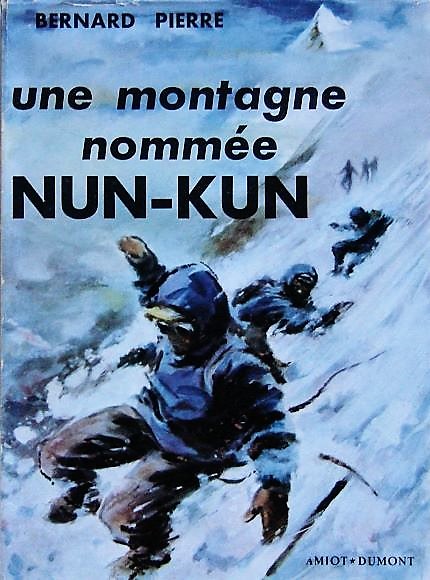
Review of Bernard Pierre’s book by D. Dangar, published in the «British Alpine Journal», in 1954, p.472-474. Une Montagne Nommée Nun-Kun. By Bernard Pierre, 199 pages, illustrations and maps, Bibliothèque de l'Alpinisme, Amiot Dumont, Paris, 1954. Source. AFTER his successful ascent of Salcantay in 1952, M. Pierre felt that he would like to attack a virgin 7,000 metre peak. [With] this in view, [he] collected a small but experienced party to accompany him. His chosen companions were Jean Guillemin, Michel Desorbay, and Madame Claude Kogan, 'une des plus remarquables alpinistes de notre époque', Pierre Vittoz (a Swiss missionary residing at Leh), and two Indian officers. The professional duties of the various members of the party restricted the time available for the expedition to the months of July, August, and September. This limited the choice of district as the monsoon is active in Sikkim, Nepal, and Garhwal, at that period of the year. The Karakorum being out of the question, M. Pierre had to find his 'seven thousander' in Kashmir. While turning over the pages of Montagnes du Monde/ The Mountain World/ Berge der Welt, he learnt that a single 7,000 m peak between Garhwal and Nanga Parbat was still virgin, and, in addition, that it was situated only one hundred kilometres from Srinagar, the capital of Kashmir. This mountain was Nun, 23,410 ft. (7,135 m), the culminating point of the Nun-Kun massif. [That was the following text written by Marcel Kurz, PhD in alpine sciences, published in «Berge der Welt», V, 1950, page 194: "N'est-il pas piquant de constater que le seul sommet de 7’000 m sur les 700 km qui séparent le Garhwal du Nanga Parbat soit resté encore vierge ? ((Marcel Kurz forgot that there was a second 7,000m peak in that area, namely the Kun)). Et cela à 100 km de Srinagar, capitale du Cachemire? Avis aux amateurs!] In his book M. Pierre has given us an enthralling account of the expedition which culminated in the first ascent of Nun on August 28, 1953. Several other parties had visited the massif; Dr. and Mrs. Workman, Dr. Neve, and H. Sillem, will all be remembered for their exploratory work. Mrs. Workman achieved a notable success when she made the first ascent of Pinnacle Peak [6,930 m, the third summit of the Nun-Kun massif] with Cyprien Savoye and a porter in 1906. In 1913, Mario Piacenza and Lorenzo Borelli, members of an Italian expedition, made the first ascent of Kun, 23,219 ft. [7,077 m], the second highest peak of the massif. Waller and Harrison were there in 1934, but Nun itself remained unclimbed.  Nun, Kun and Pinnacle. Source:
wikip (0.14 Mb)
Nun, Kun and Pinnacle. Source:
wikip (0.14 Mb)
The first three chapters of the book deal with the preparations and the journey to the Base Camp. The expedition left Doda on July 15, 1953, and then had a march of 150 miles to the South foot of the mountain. The usual difficulties were encountered en route, including a strike of the porters. The bridge over the Zaz Nal had been destroyed, and one of the Indian officers went back to the village of Metwan for assistance. The headman of the village, Mohammed Sheik, 'un magnifique gaillard, plein d'autorité et de dynamisme', without even asking if he would be recompensed, very soon collected a gang of workmen and a new bridge was quickly built. A remarkable man ! 
The 1953 Nun party.
Top row, from left to right:
Pierre Vittoz, Claude Kogan, Dr. Jean Guillemin, Michel Desorbay.
Middle row: Ang Phutar, Ang Tharkay, Bernard Pierre, Pa Norbu. Lower, front row: Gyalzen; Pemba Norbu, Kami. Base Camp was pitched on July 30, 1953 [at 4,730 m], and two days later Camp I was established at 18,000 ft. [5,490 m]. Pierre Vittoz had made a reconnaissance of the mountain in 1952 and had come to the conclusion that the West ridge offered the best chance of success as a route to the summit. 
1953: The cascade (left) and the tower (right), far up: the Nun summit From Bernard Pierre's book (0.2 Mb) 
1953: Camp I, with the cascade (left) and the tower (right), far up: the Nun summit From Bernard Pierre's book (0.2 Mb) There were two ways of access to this ridge, neither of them very attractive; by an icefall, easy but dangerous, or by a great rock tower, difficult but not dangerous. (A double page photograph between pages 112-113 shows clearly the alternative routes.) The icefall was ruled out as too hazardous, and on August 2, Vittoz and Ang Tharkay went to reconnoitre the base of the tower. They returned full of confidence 'Le Nun est dans la poche!' Bad weather then set in and the party returned to the Base Camp [4,730 m]. When conditions had improved, Vittoz and Madame Kogan solved the problem of the tower, enabling Camp II to be established on August 10 at 19,200 ft [5,850 m]. An attempt [on August 11] to establish Camp III was defeated by fog and snow, and an emergency camp was set up [at 6,250 m] in which the night was spent. Again, the weather deteriorated, driving the party back to the Base Camp [4,730 m] for a week. Time was getting short, for arrangements had been made for 70 porters to arrive for the return journey on August 28. On August 19 there were signs of an improvement and two days later [21 Aug] five climbers, with Ang Tharkay, were installed at Camp III [6,400 m]. Plans were made for an assault next day. Once again, however, there was a hopeless dawn [on Aug 22]; at 7:30 a decision had to be made – 'On ne part pas.' Snow fell most of that day [Aug 22] and the following night. By the morning [of 23 Aug 1953] it became imperative to descend. There is a graphic description of that descent, Ang Tharkay in the lead after the first few hundred metres, groping blindly downwards through fog and snow, searching for the markers which had been planted two days before to indicate the route. At last one was found, and half an hour later the emergency Camp III [6,250 m] was reached. Within sight of Camp II [5,850 m] occurred the avalanche that wrecked the author's own chance of reaching the summit. One rope (Kogan-Vittoz-Guillemin) stopped after a fall of some 150 ft. [50 m], but the other (Bernard Pierre-Michel Desorbay-Ang Tharkay) was carried down about 1,000 ft. [300-400 meter], and the three men were lucky to escape with only concussions and bruises. Bernard Pierre's account of this descent, and of his thoughts and actions during the avalanche, is extremely vivid and makes some of the most exciting pages of the book. [The following day], on August 24, with only four days in hand, all were still at the Base Camp [4,730 m]. [Two days later, on 26 Aug 1953], Vittoz and Madame Kogan, unharmed by the avalanche, left for a final assault with supporting parties to remain at Camps I [5,490 m] and II [5,850 m]. Bernard Pierre and Pemba Norbu went with them, Pierre knowing full well that owing to his injuries there was little or no chance of his reaching the summit. When they reached the site of Camp III [6,400 m], they found the camp had been obliterated by an avalanche, but they had with them a small tent in which they passed the night [the four of them crammed in the tent]. It was very cold. On August 28, 1953, the weather was good and they started for the summit on two ropes at 7:30. Bernard Pierre struggled on with great determination until he was forced to give up at nearly 22,000 ft. (6,700 m). Vittoz and Madame Kogan reached the summit of Nun in the early afternoon. 
Le Nun vu du Sud. On admire le Fer à cheval no3 et la face sud-ouest, par laquelle sont arivés les grimpeurs de 1953. Depuis la gauche, le long de l'arête ouest, on admire la "bosse" caractéristique, le "creux" ou Col de Bonne- Espérance, puis le balcon (des camps II, III prov et III) et enfin le sommet. Source: Wikip (0.06Mb) 
Drawing of the 1953-expedition path to the Nun summit From Bernard Pierre's book (0.2 Mb) 
The 1953-expedition path to the Nun summit From PV's article in the CAS journal (0.2 Mb) This is an excellent book, with sixteen pages of illustrations, maps, and several sketches, on two of which the route has been marked enabling the reader to follow clearly the progress of the ascent. None will regret the time spent in reading it, and the sympathy of all will go to the leader in the unhappy mischance that prevented him from standing on the summit with Vittoz and Madame Kogan.
D. F. O. DANGAR
Added before 05 Mar 2023; last modified 07 Mar 2025

Le Nun vu d'avion. On distingue très bien ses trois arêtes principales. Tout devant, un peu à droite, la Branche no4 (l'arête ouest) et devant, à gauche, l'arête nord-ouest (la Branche no1). Derrière plus loin, tout à droite, l'arête sud-est (Branche no3). A gauche, le fer à cheval no1, le plateau enneigé à 5'400 m d'altitude (situé entre les branches 1 et 2). PV et l'expédition de 1953 sont arrivés par le sud, posant leur Camp de Base dans le Fer à cheval no3, le flanc sud-ouest du Nun. Ils ont d’abord atteint le col ouest (entre la bosse et le mont principal), où ils ont installé leur Camp I. Puis ils ont longé l’arête ouest, y fixant leur Camp II à 5’850m. Puis ils sont repassés sur la face sud-ouest peu avant le sommet pour y installer le Camp III à 6’400 m. Ils sont finalement revenus sur l’arête ouest (la branche no4, qui à cette hauteur a fusionné avec l’arête nord-ouest, la branche no1). Ils ont atteint le sommet à 7’135 m sur cette arête ouest. Source: 360-Expeditions (0.14Mb) 
Le massif du Nun-Kun dans son ensemble, avec le Pinnacle (la petite pointe tout à gauche, reliée au Kun), le Kun (la grande pointe à gauche), le Nun (la grande pyramide au centre). Devant, la longue langue de glacier descendant du Nun-Kun. Source: DreamTime (0.18Mb) Des vidéos d'ascensions récentes du Nun (2021, 2022), conduites par des agences d'alpinisme, peuvent se visionner sur YouTube. Un joli exemple: 2021 Nun ascent. |

|
Dernière Chance au Nun Par Pierre Vittoz Article publié dans la revue du Club Alpin Suisse, Die Alpen/ Les Alpes, en 1954. Source Pierre Vittoz y raconte la fin de son expédition au Nun, à savoir la troisième et dernière tentative d'ascension, du 26 au 28 août 1953, celle qui a réussi à atteindre le sommet. Le texte est baigné d’un flou artistique typique du style de Pierre Vittoz. Aucun chiffre, peu de noms, aucune date, des références cryptiques... Dans ce langage très elliptique, il faut bien souvent déjà connaître l’histoire pour comprendre ce que PV veut dire. Je me suis efforcé de combler ces nombreuses lacunes par des ajouts entre crochets. Mais ce texte est une merveille. C'est le plus sentimental parmi les écrits de P.V. reproduits ici. Le champion y partage avec nous ses pensées, ses émotions et le bonheur de l'amitié. Il nous fait deviner les dangers extrêmes qu’il encourt. Il nous fait percevoir ce qu’est la virtuosité en alpinisme (le sixième sens des pieds sur la neige, etc.) qui à chaque pas fait la différence entre la vie et la mort. Avec des détails d'une précision hallucinante, des détails qu'on n'invente pas, il fait apparaître devant nous ce qu'est la vie quotidienne en haute montagne, à 6’000 mètres d'altitude. A la fin, PV partage avec nous la joie ineffable, intense, sans limites, qu'il a éprouvée à son arrivée au sommet, le 28 août 1953 à 15h, le jour de l'anniversaire de son épouse. Dans cet article, le lecteur revit l’épopée de la conquête du Nun comme s’il y était. On pourrait qualifier le style de Pierre Vittoz de poétique, de ramuzien même. 26 août 1953: au Camp de Base, à 4'720 m d'altitude, au pied du Nun «Maintenant pas d'histoires! Dans quatre jours vous me ramenez un caillou du sommet! D'ailleurs j'irai à votre rencontre le chercher», s'exclame Desorbay avec un grand sourire au moment où nous nous éloignons. Les blocs de la moraine [roches transportées par les glaciers] me sont familiers, et en sautant de l'un à l'autre, je jette des coups d'œil aux trois grandes tentes – deux orange, une grise – du Camp de Base. Ang Tharké a l'air affairé devant son feu de bois. Assis sur un caillou, Desorbay regarde presque dans une autre direction. Guillemin fait semblant de s'occuper de droite et de gauche. L'avalanche d'avant [survenue le 23 août 1953] a meurtri deux d'entre eux [Bernard Pierre et Michel Desorbay] et l'autre [Jean Guillemin, le médecin] a voulu rester pour les surveiller. Nous, le sac vide et les mains dans les poches, nous montons tranquillement. C'est triste de devoir laisser de bons amis et de continuer sans eux l'entreprise pour laquelle ils ont autant lutté, autant espéré que nous. Et puis nos vacances s'épuisent: quatre jours, dernier délai, avant de reprendre la longue marche de retour. Après un mois tout haché de pluie, de neige, de vent, quatre jours... Mais la marche cahotante sur la moraine me remet doucement en train: d'abord les jarrets, puis les poumons et la tête. Comme il fonctionne bien, mon corps! Comme je suis bien entraîné, et peux marcher vite, et régulièrement! Le ciel s'est nettoyé. Depuis hier, vent et cirrus ont disparu – la chance est peut-être pour nous. Surtout à trois mètres de moi trottine cette étonnante petite femme, Claude Kogan, qui semble ignorer l'altitude et la peine. C'est avec elle déjà que j'ai vécu la journée la plus dure de l'expédition: des pentes de neige fondante, des rochers enfarinés, des murs de glace, des contremarches, des cordes à fixer... jusqu'à la nuit. [Allusion peut-être au 8 août 1953, quand les deux ont ouvert le chemin vers le Camp II à 5’850 m] Avec elle, on arrivera bien au sommet du Nun! Il s'agit de ne pas traîner. Nous quittons bientôt la moraine pour prendre le glacier qui vient du col ouest, où se distinguent les pignons des tentes du Camp I (5’490 m]. L'été a ruiné le glacier: les belles pentes ont disparu, la misère de la caillasse traîne sur la glace, même les tables glaciaires ont glissé de leur piédestal auquel [sur lequel?] elles s'appuient de travers, rappelant la terrasse d'un café un jour de pluie. Devant nous, une tache bleue: c'est Bernard Pierre, qui a voulu nous accompagner; lui aussi a été éprouvé par l'avalanche [d’il y a trois jours], mais il est le chef de l'expédition, il tient à participer à la dernière tentative. Il est parti en avant et monte lentement, péniblement. Perchés sur un rocher babillent les sherpas. Leurs sacs sont presque vides, le temps ne presse pas pour eux. Ils ne résistent pas au besoin de m'interpeler: –Corps précieux, bon Corps précieux! [Rappelons que Pierre Vittoz conversait avec les sherpas directement dans leur langue, en tibétain.] C'est le beau. [Le beau temps?] La cheftaine [en fait, les sherpas l'appelaient Memsahib] arrivera au sommet. Mais tenez-la bien! Au Camp I, nous avalons une tasse de pemmican et repartons [au lieu de rester pour la nuit, puisque normalement chaque camp est placé à l’endroit où il faut s’arrêter pour dormir]. Nous voulons gagner une journée. D'ailleurs, à l'allure où nous marchons, ce sera facile. Il faut d'abord descendre et traverser une combe de neige, puis attaquer les pentes de l'arête ouest. Les dernières chutes de neige ont effacé les centaines de marches que nous y avions tracées, mais ont aussi recouvert la vieille glace. Aussi me contenté-je de donner un coup de piolet par-ci, par-là, et de dégager les cordes fixes [càd les cordes fixées aux parois pendant les tentatives d'ascension précédentes – par opposition aux cordes mobiles, liant les grimpeurs les uns aux autres] Les sherpas sont à l'aise sur leurs crampons et malgré une crachée de grésil, c'est avec brio que nous grimpons ces pentes raides pour la quatrième fois. L'arête s'élève depuis le col ouest en deux grandes tours [successives]. La première, rocheuse et haute de deux cents mètres, doit être tournée par le flanc nord glacé [donc à gauche, en montant]. La deuxième, la tour supérieure, mesure bien quatre cents mètres, et après avoir culminé à 6’000 mètres va s'appuyer [plus bas] à un glacier suspendu qui défend les dernières pentes du sommet. Il faut suivre l'arête de cette seconde tour au-dessus d'une paroi fantastique qui tombe en direction du Camp de Base [donc à droite, en montant]. Puis, un peu avant son sommet, nous nous glissons sur la gauche pour atteindre une vire glaciaire [une grotte, une alvéole dans la glace/ un endroit où le glacier tourne?] où est niché le Camp II [5’850 m]. Matin du 27 août 1953, au Camp II (5’850 m) Voilà un bon quart d'heure que nous nous habillons, et c'est loin d'être terminé. Moi qui croyais n'avoir presque rien ôté avant de me glisser dans mon sac de couchage! Il est vrai que nous déballons des morceaux de nougat tout en laçant nos pantalons imperméables, et que la tente nylon a la mauvaise habitude de s'affaisser et de se couvrir de givre à l'intérieur. Chaque fois que j'essaie de bouger, ma tignasse balaie les cristaux de glace et m'en asperge la nuque. Peu à peu pourtant, à force de ramper d'un coin à l'autre, nous dénichons gants, guêtres et casquettes au fond des duvets ou sous les matelas, rassemblons le tout et sortons des tentes. La pyramide blanche du sommet, parfaitement régulière avec son arête qui plonge vers nous, présente sur la droite le triangle de la face lisse que nous voulons escalader. Le soleil illumine déjà la face, mais n’est pas encore descendu [sur] l'escalier de séracs que nous devons grimper aujourd'hui. Une belle journée, calme et froide, qui nous ramènera au Camp III [6’400 m], d'où nous avons dû fuir l'autre matin [le 23 août 1953] sous la bourrasque. Et demain, si ce temps dure, ce sera la face de neige et le sommet! Ce sommet qui nous refuse depuis un mois... Le départ est joyeux, les sacs légers: nous n'emportons qu'une tente et quelques duvets pour compléter le Camp III. Mais bientôt nous piétinons dans une neige gaufrée où le vent a superposé la poudre et la croûte cassante. Que c'est énervant... et instable! Voilà justement l'endroit où une plaque de neige nous a emportés, triturés, suffoqués [l’avalanche du 23 août]. Je sens encore mes jambes s'enfuir avec la pente, et mes doigts griffer furieusement la neige. Et je revois – je verrai encore longtemps – le masque affreusement crispé du camarade [Michel Desorbay] qu'il fallut arracher à la neige. Nous traversons lentement la place, cherchant en vain les traces qui expliqueraient [cette catastrophe]... Le vent a tout effacé. Plus loin le talus se redresse, la neige a l'air meilleure. Cette énorme crevasse pontée, je la connais pour l'avoir longuement sondée: elle est solide. [Mais soudain] Brouf! Le pont s'est tassé et fissuré sous mon poids. Je continue comme sur des charbons jusqu'à l'autre bord, où Claude me rejoint à pas feutrés. Indécis, les sherpas attendent en souriant; Pa Norbu reçoit en pleine figure la corde que je lui lance; son sourire ne fait que s'élargir. Un chapeau de brume a coiffé le sommet [du Nun]; puis le vent l'a dérangé, il a glissé en un instant et s'est posé sur nous. Encore une pente raide pour franchir un mur de séracs, une combe de neige croûtée, et nous faisons halte près d'un bloc de glace qui coupera le vent aigre. Le grésil tambourine une fois de plus sur nos capuchons. Encordé avec un sherpa, Bernard Pierre nous rejoint lentement, les traits tirés, la main sur le flanc dont l'avalanche a froissé les côtes. Comme elle est voûtée, cette carrure qui lui a valu le surnom d'«ours noir» parmi les sherpas! Son allure, l'absence de mes autres amis, le temps toujours incertain, tout me pousse à la mélancolie. Voilà que même Claude se met à grelotter et me demande de lui frotter son dos transi. –Est-ce que la cheftaine a des puces? glisse Gyaldzen en tibétain d'un ton respectueusement inquisiteur. L'éclat de rire nous remet sur pieds, et je reprends la trace avec entrain. Le brouillard est opaque, la neige profonde, et je ne distingue rien dans cette blancheur. Il doit y avoir un drapeau après une centaine de mètres, par là-bas... le voici. Le suivant, à peu près dans, cette direction, est au-dessus d'une crevasse. Boussole... Bon, en plein dessus! Ensuite nos jalons s'espacent, mais un peu de chance et de mémoire des pentes nous maintiennent dans la direction où nous avons placé le Camp III [6’400 m]. Mais quelle [épaisse] neige! Que sera demain avec une pareille corvée à 7’000 mètres? [Je m’exclame:] –Claude, on doit y être [au Camp III]. [Claude:] –Oui, un peu plus haut peut-être... [Je lance aux sherpas:] –Eh, petits frères, vous ne voyez rien à droite ou à gauche? [les sherpas me répondent] –Non, Corps précieux [P.V.], il n'y a rien. –Là-haut, à vingt mètres, une tente! –Non, un bloc de glace... –Là-bas?... –Un autre sérac. Étrange, je ne me souviens pas de tous ces énormes débris. Pourtant nous sommes bien au pied de la face sommitale, sur la faible pente du camp, le seul demi-plat des environs. L'appréhension me serre aux genoux: Est-ce que... [une avalanche se serait abattue sur le Camp III]? Mais non, ce serait trop de malchance... Pourtant, cette barre de séracs, cent mètres au-dessus du camp?... La brume s'éclaircit, nous attendons haletants [que notre regard puisse enfin embrasser toute l'esplanade]. Et brusquement nous nous trouvons assis dans la neige, comme si nos jambes avaient fondu: des blocs énormes jonchent le centre de la pente, et partout autour – sauf la traîne qu'ils ont laissée en s'écroulant – il n'y a rien que la neige blanche sans la moindre trace [du Camp III]. Je me prends à regarder jouer mes doigts, comme surpris qu'ils soient encore vivants... Voilà ruinée notre dernière chance [d'atteindre le sommet]. Il faut redescendre avant la nuit, abandonner ce Nun que je convoite depuis trois ans [Trois ans? Donc l’expédition au Nun s’envisageait depuis 1950?!], dont mes amis ont préparé l'escalade depuis dix mois! [Claude s'écrie:] –Je demande la permission de rester! [Je m'aligne:] –Je reste aussi... [Bernard Pierre s'insurge:] –Vous êtes toqués, c'est du suicide! –C'est toi l'idiot, ces séracs ne retomberont pas. –Deux avalanches ne vous suffisent pas? Nos nerfs sont [à vif], nous nous lançons les pires injures comme des boules de neige. Les sherpas, gênés, jouent avec les bretelles de leurs sacs. Après vingt minutes stupides, aussi brusquement qu'elle a éclaté, s'éteint notre fureur: nous resterons tous trois dans la tente que nous avons apportée, sans réchaud ni vivres. D'un air que je voudrais serein, je creuse une terrasse [pour y planter la tente] à quelques mètres des débris. Travail exténuant, dit-on – [mais] passe-temps adoucissant, très recommandé en cas de nervosité extrême... Les sherpas m'aident volontiers, comme si les chutes de séracs étaient routine pour eux. Puis nous allons sonder les franges de l'avalanche, dans l'espoir peut-être que l'Himalaya pardonne entièrement les erreurs... [càd dans l’espoir de trouver des restes du Camp III]. Comme s'il ne nous avait pas suffisamment pardonné en nous faisant quitter la place avant de frapper son coup! [Intéressante personnification de la Montagne, analogie sous-jacente entre le seigneur montagneux et un dieu] [Pierre Vittoz à un sherpa:] –Le grand chef [Bernard Pierre] aimerait un sherpa à sa corde pour tenter le sommet demain. Veux-tu rester, petit frère? –À vos ordres, Corps précieux... [Mais] je préfère redescendre… –Et toi? –Pemba Norbu est plus petit que moi, il réussira à se glisser sous la tente avec les sahibs! Dévoué parmi ces hommes dévoués, Pemba Norbu sourit. Il sait qu'il n'atteindra pas le sommet, qu'il passera une piètre nuit sans espace, ni thé, et que pour récompense il pourra remporter le matériel... Il sourit parce que son idéal n'est ni de gagner de l'argent, ni même d'escalader les sommets, mais de servir ceux qu'il accompagne, de se dévouer pour nous avec ou sans sommeil, avec ou sans souper. Nous nous faufilons sous la tente minuscule. Bernard s'allonge d'un côté, Claude, Pemba et moi nous accroupissons en face de lui sur nos sacs de couchage. Une bougie s'allume, Pemba Norbu va passer la soirée à fondre quelques poignées de neige pendant que nous nous ingénions à avaler du jus de fruit glacé et à éviter les crampes... A vingt mètres peut-être dorment tentes, réchauds, appareils de photo... Matin du 28 août 1953 au Camp III de secours (6’400 m) Au petit jour, l'amas de duvets qui emplit la tente se met à remuer. Lentement on se redresse, on se passe la langue sur les lèvres. On écarte la toile pour regarder le ciel: grand beau. Pemba Norbu rallume sa bougie et prépare quelques gorgées d'eau. La bouche en feu, nous nous équipons longuement et sortons. La neige est poudreuse, profonde, et il faut pousser ferme sur les cannes [bâtons] de ski pour [avancer et] tracer un sillon dans la combe qui monte à droite vers l'arête sud. Claude avance en somnolant encore sous l'effet d'un soporifique. Bernard suit à vingt mètres avec Pemba. Notre intention était de grimper entre les séracs de la face, mais la pente nous pousse de plus en plus à droite. Je me décide à franchir une petite rimaie et un talus de glace pour atteindre l'arête [sud] et le soleil. Il est temps de nous réchauffer; le vallon poudreux était dangereusement froid. Corniche? Non, mais une croupe tombant en séracs et en précipices de deux mille mètres. Nous nous arrêtons. Bernard a une main inerte, Claude bat ses pieds l'un contre l'autre, Pemba Norbu se plaint de ne pas sentir ses orteils. Massages. Nous repartons en jalonnant la route en prévision de la brume d'après. La neige est soufflée, les crevasses camouflées. Droit au-dessus de nous la grosse barre rocheuse qui soutient le sommet et s'appuie sur un glacis de neige raide. L'arête soudain s'interrompt; à trente mètres commence le glacis séparé de nous par un énorme fossé. Mais deux lames de glace franchissent la crevasse, et nous passons en équilibre sur [l'un des deux feuillets blancs], tandis que nos ombres se découpent contre l'autre. Nouvel arrêt. Bernard ne sent plus ses pieds. Avec Pemba nous les frottons longtemps en vain. Atroce sensation: j'ai l'impression de masser les pieds d'un mort... La volonté de mon ami n'y peut plus rien: il n'est pas en état de continuer. Le temps presse. Claude et moi devons partir pendant que Bernard tourne son dernier mètre de film [il avait emporté une caméra] avant de se résoudre à redescendre avec son sherpa. La pente de neige, dominée à droite par le grand ressaut rocheux et à gauche par l'arête ouest, monte d'abord faiblement, puis [d'une manière] très raide jusqu'à deux rochers qui marquent le tiers de sa hauteur. La neige n'est qu'une croûte ventée qui sombre dans une poudre instable. Que de fois je me suis déjà vautré dans ce genre de plâtras, à pleines jambes, à pleins poumons, avec une joie sauvage! Mais au Nordend, au Täschhorn et ailleurs je croyais la neige sûre; j'avais confiance. Aujourd'hui je vois l'avalanche à chaque pas... Ces rochers semblaient à portée de la main. Malgré notre hâte, ils se rapprochent à peine. Quand enfin nous les touchons nous respirons: une étape est derrière nous, et ce perchoir au moins ne risque pas de glisser [et de nous emporter]. Juste au-dessous de nous, au Camp III, Bernard et Pemba se massent les pieds, s'installent. Plus loin dans les séracs monte une cordée – les trois sherpas que nous avons renvoyés hier soir, mais qui reviennent avec du matériel. Sans doute aux flancs de la grande tour peinent Guillemin, Desorbay et leurs sherpas qui malgré accident et contusions sont prêts à nous soutenir. Tant de travail et de dévouement pour une paire de grimpeurs accrochés à un sommet! Au-dessus de nous, la pente faiblit un peu puis se redresse à un angle difficile à évaluer. Claude voudrait monter tout droit pour éviter de couper les pentes; je préfère traverser à gauche jusqu'à l'arête ouest avant que ce soit trop raide. Les deux solutions sont mauvaises. [Il faudra faire une combinaison des deux.] Nous nous prenons à lorgner vers le bas, vers la sécurité. Le Nun mérite-t-il que nous risquions notre peau sur des plaques de neige ventée? Il faut nous secouer, avancer. Claude attaque la face. La marche est pénible même pour le second. Ma compagne grimpe tout droit. Elle plante son piolet devant elle et se hisse lentement d'une jambe sur l'autre. Mais bientôt elle rencontre de grandes plaques de neige soufflée qui la font incliner à gauche. Ces plaques à vent dessinent de longs festons attachés en oblique à l'arête ouest. Craignant qu'elles ne supportent pas notre poids, nous en suivons le bord inférieur en une traversée de plus en plus horizontale. Souvent ni crampons ni piolet n'accrochent une neige sûre. Nous n'osons plus faire d'efforts violents de peur de déchirer une plaque, et devons nous glisser patiemment pas après pas sur la neige en farine qu'il est impossible de tasser. [L'aveu de PV, replongeant sur cette matinée de grimpe, 20 ans plus tard, en 1973: "Au Nun-Kun, Claude et moi avions pris un risque énorme en grimpant un long matin sur des plaques à vent qui sonnaient creux. J'en ai gardé un goût amer, que n'a pas supprimé le goût de triomphe du sommet." Cf. "Brenva vingt ans après".] Le soleil frappe en plein la masse fragile et semble la miner de minute en minute. Près de l'arête, la pente se cambre. Heureusement nous trouvons une bande de neige dure où Claude, à petits pas étudiés, s'avance vers le ciel. Son piolet brille, elle le passe par-dessus la crête. Du coup les visions d'avalanche s'évanouissent et nous nous trouvons riants sur une arête bonasse qui mène tout droit au sommet. Midi et demie... le Nun est à nous! Le sommet semble tout proche. Je pose mon sac et j'entreprends de faire vivement la trace [càd de créer un chemin, en partie en écartant et en partie en tassant la neige]. La neige pourtant est instable une fois de plus: à droite de la crête le soleil l'a minée, à gauche elle est poudreuse, folle, et le fil même de l'arête repose sur une pourriture sans consistance. La neige m'a toujours plu. Cette mauvaise neige me passionne. Pas de coups de pied, pas de moulinets du piolet. A mesure que mon pied s'enfonce, j'essaie d'évaluer la cohésion de la poudre ou des gros cristaux, de savoir jusqu'à quand la neige va supporter mon poids et quand elle risque de s'effondrer. Il me semble qu'un nouveau sens se développe à travers mes lourds souliers, un sens qui juge d'un matériau toujours changeant. C'est l'art de l'équilibre qui entre en jeu pour qu'aucun heurt, aucune torsion subite de la semelle n'accompagne le passage d'un pied sur l'autre. Il y faut aussi l'art du rythme pour monter vite et sans fatigue – un rythme subtil qui s'adapte aux changements de neige. Une fois cet équilibre et ce rythme acquis, j'aime à me laisser bercer par mes jambes, la tête libre et rêveuse, les yeux pleins de l'éclat de la neige. Vers 2 heures, une légère brume nous entoure. Sur l'arête devenue très raide, la neige s'est amassée en congères où il faut tracer une tranchée harassante. Ma camarade insiste pour que nous nous relayions à chaque longueur de corde, et semble trouver tout naturel de faire la trace [une fois sur deux]. Lorsque vient mon tour d'attendre, mes yeux restent rivés à sa petite silhouette bleu-ciel posée sur l'arête immense: d'où vient donc la volonté qui tire cette femme dans une neige épuisante au-dessus de 7’000 mètres? Dans la brume, on distingue des rochers aux flancs de l'arête. L'un après l'autre, chaque bloc est dépassé, et nous débouchons sur une calotte blanche. Une tour rocheuse avec un grand bec sur la gauche [le sommet!] apparaît à notre niveau. Comme c'est encore loin! Mais la brume nous a trompés et en un instant nous sommes au pied de la tour. –Passe devant! –Non, tu mérites de toucher le sommet en premier. –Et toi donc?... Claude se décide. Un ressaut la cache. La corde file, puis s'arrête. Une vague de joie m'assaille: elle est au but. Mais sa voix arrive, claire: –Viens, les derniers mètres sont plus larges, on peut monter ensemble! Et, les yeux rivés sur l'extrémité de cette petite crête de neige qui s'arrête en plein ciel, nous avançons bras dessus, bras dessous, lentement, pour mieux savourer notre immense joie. Espoirs, tentative de l'an dernier, préparatifs, efforts, progrès et déceptions, tout cela se concrétise, s'accomplit en ce minuscule dôme de neige où nous nous asseyons radieux. Nous oublions fatigue et soif, même les dangers de la descente, et nous rêvons. Nous rêvons en une extase irraisonnée et inexprimable qui s'harmonise avec la brume rousse et le soleil diffus. Peu à peu pourtant s'ordonne cette joie sans mesure. Devant mes yeux tout pleins de visions brillantes se présentent des visages. D'abord ma femme. Elle pleurait, voilà deux mois, quand j'ai cru que je ne pourrais me joindre à l'expédition. C'est aujourd'hui son anniversaire. Quel cadeau de fête! Voici la petite silhouette de ce compagnon [Edmond Pidoux] de tant de vagabondages, qui a tant contribué à me façonner en grimpeur... et en homme. Et d'autres. Et les camarades, Français et sherpas, échelonnés aux flancs de la montagne, qui attendent avec confiance le succès de notre grimpée. Joie pour eux et pour moi! Mes amis! D'entre eux, seule Claude est en face de moi; mais sa ténacité et sa douceur me les rappellent tous, les représentent tous devant moi. Des amis! Depuis trois ans, en solitaire, j'ai parcouru des faces, escaladé des arêtes – de belles courses, dans cet Himalaya merveilleux. Je n'y ai ressenti qu'une demi-joie parce qu'aucun compagnon n'était là pour illuminer les marches et les haltes. Mais aujourd'hui, j'ai des amis!... Peut-être ai-je cherché à la montagne un jeu, un terrain à exploits, ou une «chambre haute» (1). J'y ai surtout trouvé la joie de l'amitié. ... Et n'oublions pas d'emporter un caillou pour Michel... (1) Allusion à un recueil de poèmes alpestres composés par Edmond Pidoux, le compagnon mentionné quelques lignes plus haut. Note Complémentaire de Pierre Vittoz ("Die Alpen/Les Alpes", Revue du CAS, 1954). Note qui aurait dû paraître dans le numéro de fév.1954) (Cette note fourmillant de noms, de dates et d'altitudes prouve que P.V. pouvait, quand il voulait.) Par suite d' un malentendu, cette note complémentaire, qui aurait dû accompagner le récit de Pierre Vittoz dans le numéro de février 1954, est restée dans un tiroir. Mieux vaut [la publier] tard que jamais. Le Nun, 7'135 mètres, et le Kun, 7'085 mètres, situés à une centaine de kilomètres à l'est de Srinagar au Cachemire, forment le groupe montagneux le plus important entre le Nanga Parbat et le massif du Garhwal. Il fut exploré dès le début du siècle – du moins son versant nord – et le Kun fut escaladé par Piacenza en 1913. Deux expéditions au Nun, en 1934 et 1946, atteignirent 6'600 mètres sur son arête est. Sur l'étude des documents et à la suite d'une reconnaissance que je fis en 1952, l'expédition dirigée par Bernard Pierre en juillet-août 1953 s'attaqua par le sud à l'arête ouest. L'équipe, composée des Français B. Pierre, Mme Claude Kogan, Dr J. Guillemin et M. Desorbay, et des Indiens Flight Lt Jayal et Capt. Jahori eut la grande amabilité de m'inviter à la rejoindre, puisque j'étais sur place ou presque. L'itinéraire ne présente de difficultés objectives que dans la partie inférieure de l'arête ouest, mais le temps incertain et d'abondantes chutes de neige nous prirent beaucoup de temps. Après deux semaines de marche d'approche le camp de base fut établi à 4'700 m. le 30 juillet 1953. Le camp I planté sur le col au pied de l'arête ouest à 5'400 m. le 1er août. Le camp II fut occupé le 9 août et le camp III à 6'400 m. le 21 août 1953. Le sommet ne fut atteint que le 28 août 1953 et l'expédition était de retour à Srinagar le 9 septembre. Nous étions accompagnés du fameux Ang Tharke et de cinq jeunes sherpas. P. Vittoz |
|
ASCENT OF THE NUN (23,410 ft.) By Pierre Vittoz Article published as a chapter in the book/ hard cover journal The Mountain World 1954, 224 pages, edited by Marcel Kurz, Ruskin House, George Allen & Unwin, Ltd., London, 1954. PDF version. FOREWORD [by Bernard Pierre:] Tilman has said that the one who hears the call of the Himalaya would do well to find the road there [bad translation]. However, I cannot help comparing this road to a difficult steeplechase, the major obstacle of which—its big ditch—is obtaining authorization. Thank God! it had been secured [authorization for the whole expedition to the Nun in Jul-Aug1953], not without difficulty or delay, forty days before departure. In all innocence and as if to intensify the difficulty, we had asked for authorization to enter a region that was politically aflame and suffering from spasmodic outbreaks: Kashmir. No more, no less! But, as Corneille’s hero claimed, “Conquering without danger means triumphing without glory”. The aim of this expedition was the Nun (23,410 ft.), the highest point in the Nun-Kun massif, situated east of Srinagar. Why the Nun? Our jobs forced us to undertake a Himalayan campaign during the summer and we had to escape the monsoon; Kashmir seemed to be sheltered from it. We then had to look for a mountain of 7000 m. (23,000 ft.). In my search I came upon a sentence by Marcel Kurz—that doctor of alpine science—in Berge der Welt, V, 1950, page 194: “Is it not strange that the only seven-thousander [actually, there are two 7,000er: Nun and Kun] in the 700-km. stretch between the Garhwal and Nanga Parbat, only 100 km. from Srinagar, the capital of Kashmir, should be virgin? Mountain-lovers take note!” They did, and they numbered seven: a Swiss, two Indians and four French: an international expedition. The Swiss, a missionary, had been brought to my notice by Kurz (the same Kurz as before!). Having lived for three years in Leh (Ladak), 100 km. from the Nun, Pierre Vittoz converted souls while occasionally tormenting the six-thousanders. The two Indians had both participated in Himalayan expeditions, Capt. K. C. Johori on that to Kamet in 1952, and Lt. N. D. Jayal (who had flown over Everest after its conquest) on that to Kamet and, in 1951, one to Trisul. The four French already knew something about climbing distant mountains: Claude Kogan (of the so-called weaker sex) and Dr. Guillemin were members of the Franco-Belgian (1951) and Franco-American (1952) expeditions to the Peruvian Andes. Michel Désorbay had led an expedition to Spitzbergen, and Bernard Pierre, after participating in an expedition to the Hoggar in 1951, was the promoter of the Franco-American expedition to Salcantay in 1952. As to the principal actor, the Nun, it had been the object of two serious British attempts, one in 1934 and the other in 1946, which came to nothing (by the eastern ridge). On the other hand, the western ridge seemed to offer a better chance of success. My conviction was supported by the reconnaissances carried out by Waller in 1937 and Vittoz in 1952. New Delhi was the assembly point for the members of the expedition and the Sherpas (Pa Norbu, Ang Phutar, Ang Kami, Gyaldzen, Pemba Norbu) under the orders of that remarkable sirdar, Ang Tharke. Only Pierre Vittoz was missing, for his filly «Authorisation» (authorization to leave Ladak!) almost fell at the last fence. But taken well in hand, it caught up with the bunch at Doda on July 14th. It was at this little town, situated south of the Nun-Kun massif (the route from Srinagar to Leh having been forbidden at the last moment) that the approach march of about 150 miles began. More than go miles of typically Kashmir valleys were first ascended with two tons of material on the backs of mules. At Yurod, the mules passed their loads to a hundred coolies. On July 26th the expedition at last delightedly caught sight of the Nun. I now hand over the story to one of the craftsmen of the victory—and what a craftsman! — Pierre Vittoz who, it might be said in passing, seemed to me the perfect model of the Himalayan man in heart and limbs and wind, and above all with a stomach ready to digest any kind of preserved food that can be found, including the canned kind. Bernard Pierre MAIN ARTICLE (by Pierre Vittoz) [During my reconnaissance of the Nun, in September 1952] Impatience made me force the pace: the Nun ought to appear [further along the] bend of the valley. Slowly a rock face slid to the left and made it possible for me to see a great snow crest. How beautiful it was! While marching, I began to work out an itinerary on those vast slopes. But what was this? Behind the rock face that was moving aside appeared a ridge of ice. A few more steps and this new ridge was as high as the white crest. Then it was even bigger and the face that supported it became enormous. Where would this immense and rectilinear crest come to an end? At last the pyramid of the Nun rose up in its entirety. Crystalline, glittering under the September [1952] snow, it does not dominate any other summit; it asserts itself simply and indisputably. The Tibetans have given it a charming name: Shel Changma, “the crystal willow”. Even the K’un, almost its twin in height, seems planted there like a dark and hunched subordinate, to form a contrast with the whiteness and purity of its lines. In that Autumn of 1952, a few days sufficed to settle my mind: of the three routes suggested by the mountain’s structure, the eastern ridge seemed too long and difficult; the northern ridge led to summit slopes that were too precipitous; the western ridge, steep but regular, was easy of access from the north, whence I was coming, and seemed the best. It remained to climb it. The Nun-Kun massif is 60 miles east of Srinagar and had already interested more than one Himalayan. –In 1903, Sillem discovered the great northern glacier (1) and the snow plateau which separates its two main summits [Nun and Kun]. –In 1906 the Bullock-Workman pair spent three months in the massif, climbed Pinnacle Peak (22,737 ft.) and ascended the great Shap’at Glacier to the east. –In 1913, Piacenza, the conqueror of the Furggen, climbed the K’un (23,246 ft.). –Only in 1934 did anyone attack the Nun (23,410 ft.) the highest summit between the Garhwal and Nanga Parbat. By way of the Shap’at Glacier, Harrison and Waller reached the White Needle (reckoned as 21,980 ft., more probably 21,650 ft.), a shoulder of the east ridge. –In 1937 Waller came back to try the west ridge, but with him he had only three coolies and, following a paroxysm of toothache, had to turn back with an interesting photo as his only trophy. –In 1946 Berry took up the east ridge again, but did not get beyond the White Needle. Following upon their Peruvian explorations, Madame Claude Kogan of Nice, and the Parisians, Bernard Pierre and Dr. Jean Guillemin, began to take sidelong glances at the Himalaya. With one young man from Lyon, Michel Désorbay, they organised an expedition to the Nun for July and August 1953, and were kind enough to invite me to join them. While I continued to live [far away in remote] Ladak on the Upper Indus, they arranged all the details [from France], secured their visas, enlisted two Indian officers, Flight-Lt. N.D. Jayal and Capt. K.C. Johori, and engaged Ang T’arke, with Ang P’ut’ar his brother, Gyaldzen VII, Pa Norbu, Kami and Pemba Norbu (3). [One year later, during the expedition proper, in July 1953] There was only one annoyance: we had to approach the Nun from the south, which I did not know [having explored in September 1952 only the northern side, where we had originally planned to start the ascent]. On July 14th, 1953 we came together [or rather: On July 14th, I joined the rest of the party who had arrived at the village of Doda] near Jammu at the foot of the Chennab Valley, which we were to follow through Kishtwar, in order to continue due north, ascending the Marai and Krish Nai rivers. The sun was crushing. Half-naked, we grumbled our way through six stages, always hesitating between the sweat of walking and the grilling that riding on the wretched mules became. The temperature was phenomenal to the point of reducing even the Parisians to silence. The Sherpas were more talkative and as they had come straight from either D’aulagiri or Everest, their reflections on André Roch and John Hunt gave me some good moments. As merry as they were devoted, Ang T’arke and Gyaldzen were to entertain us with their repartee and pranks for two months. At the end of the mule track, at Naopachi (Napaz to the topographers), a village where all the coolies had to be recruited, there was the traditional comedy: impossible to go higher, since the bridges were destroyed. Besides, there never had been a road there. Moreover, bears were so numerous that no one was willing to leave his village. The conclusion was that the porters demanded seven rupees a day. But Bernard Pierre, with his experience of Arabs and South Americans, was a worthy expedition leader: he secured an overall price of eighteen rupees per coolie for what was to be six days’ ascent and three days’ return. Luckily, there proved to be only one destroyed bridge; a patrol sent out on reconnaissance was able to rebuild it in two days. As to the bears, an inexhaustible topic of conversation, two of them were seen one evening by a party which had probably had too much cognac. Apart from the bears, our preoccupation was how to approach the Nun. We were fully agreed to attack the west ridge. But how were we to reach it? The Krish Nai Valley took us to 13,000 ft. (4,000 m), at the foot of the southern side, a formidable precipice. Could we find from there a track to the pass at the base. of the west ridge, which was placed at 18,700 ft. (5,700 m)? This point, which seems never to have been reached, we called the “Col de Bonne Espérance” (Pass of Good Hope), because we presumed that what followed would be simple. But, to get there, we had no other data than a vague and fanciful map. So it was with the pleasure of upstarts that Désorbay and I, ascending grass slopes and moraines, on July 29th, discovered a gentle glacier which descends straight from the pass, and there we chose the site of our Base Camp near to its tongue. The next day we led the whole caravan thither and began excavations on the crest of the moraine at 15,420 ft. (4,700 m). The Nun was too close to stand clear; its black monstrous rampart overwhelmed us. On the other hand, opposite us, behind a wide white summit, a snow face, cut into grooves, formed a Himalayan counterpart to the fantastic slabs of the Fitz Roy, and we never tired of watching the light and the clouds playing among the hitherto unknown but soon familiar ridges. On August 1st, 1953, Pierre, Jayal, the Sherpas and I left in the direction of the pass. The moraine and the glacier were easy and we rose regularly, while the summits surged up around us. At the foot of the pass, we halted. Should we climb straight up or seek a way elsewhere? The Sherpas did not fear the slope and after a hard effort we dumped our loads on the dry and sunny side of the Col de Bonne Espérance. A glance at the altimeter showed it was only 17,700 ft. (5,400 m), so there were still another 5,580 ft. (1,700 m) of the ridge before the summit. While Camp I was being set up, we passed the glasses [jumelles binoculars] round, surprised and then anxious: the west ridge (the base of which was at our level, 300 yards to the east) at first rose in two great leaps, then lost itself in the south-west face. A secondary rib, issuing from the precipices of the north-west face, then replaced it and rose was straight to the summit. Between them, a hanging glacier plunged in seracs (permanent glaciers hanging along cliffs) to our left after being fed by the upper slopes of the south-west face. But this is what was so serious: the two leaps of the lower ridge seemed impassable. They were too steeply inclined, especially the upper one, which culminated in a large tower. To the right they fell in a vertical wall towards the Base Camp; to the left they were armoured with ice that was too steep. The following morning [Aug 02], while our companions took photographs on the plateau to the north of the pass, Ang T’arke and I went to prowl about on the staircase of séracs on the north-west face. All the slopes were streaked with avalanche tracks. We did some fine ferreting in every corner, but the staircase was too rickety. And then it became steep; I saw this from the pace of Ang T’arke, who was recutting the steps which I had carelessly made with a blow of my axe. We quickly tired of these unhealthy slopes and went back, passing around the foot of the west ridge. [In summary], this ridge was not so bad; it could be climbed, it had to be climbed! Strengthened by this certainty, which confirmed what I had seen the previous year in profile, I returned to Camp I. Pierre, Désorbay and Guillemin had just arrived and were incredulous and recalcitrant listeners: “You’re dreaming! Climb that tower at nearly 20,000 ft. (6,100 m)? It would be difficult even in the Alps. It’s a trap! How are you going to get the Sherpas past it?” In reply, the next day brought a squall [bourrasque] that chased us back to the Base Camp. On August 6th, Ang T’arke, Pa Norbu and Gyaldzen, the three best of the Sherpa climbers, and myself welcomed Madame Kogan to Camp I. The porters made up their minds to tease their missionary: —“Precious body, where shall we erect the tent for the lady chief?" —“The lady will sleep in my tent, little brother.” —“And what about the proprieties?” [i.e. Is it appropriate? Is it suitable? What about the applicable rules?] —“That will be no trouble.” —“But, precious body, you are a lama...” (When, a month later, some romantic journalists wanted to headline “a woman and a priest”, Gyaldzen, in a sententious tone, commented jokingly: “I told you so; you should take care!”). But the lady chief, seated on a stone, did not understand or seemed not to understand [the discussion over her tent allocation]. With the glasses to her eyes, she disparaged my find: “We’ll be fine on that tower; one day of snow...” However, the next day [Aug 07] we reached the foot of the ridge. The first tower, 650 ft. high (200 m), had to be turned on the left through a small valley of ice. The slope was steep but cutting was easy. Bent over the white page of my imposition (?), I sometimes cast a glance backward to see how my “tourist” [Ms Claude Kogan, who was just joining the elite team] was getting along. Perfectly at ease on her crampons, she soon insisted on relieving me. The astonished Sherpas followed lightly with small loads. Half-way up, a rock outcrop provided relaxation for arms and eyes. The slow ascent continued and for lunch we reached the saddle beyond the tower. We did not resist the desire to get to the top of this first tower while Ang T’arke was already searching for a terrace on which to pitch camp (Camp II). “Just a minute, elder brother”, we said, “the day isn’t finished yet.” ((We want to climb further and set up Camp II further away higher in the mountain)). The main buttress rose above us for another 1,300 ft. (400 m). Distorted by perspective, it looked easy. And it was ((…in the beginning)). By slopes of broken stone and névés we had soon ascended a third of it, as far as the foot of a ramp of very steep ice overlooking a couloir on the south face. There a rope had to be fixed. The Sherpas installed themselves on the highest rock and began to unroll the thin nylon rope tied to my belt. At the end of two hours they had unrolled about 400 ft. (120 m) and Madame Kogan went with a snow-scoop to get water for her exhausted companion (Pierre Vittoz). Then she took the lead and led us leftwards over some snow-covered rocks. I knew that from this precise point, by crossing the rib of snow that rose up for 6o ft. on our left, we might be able to turn the summit of the tower by a ledge of séracs. But the rib seemed to us too steep and we continued straight on into a mixed terrain that was quite difficult. A little before 5 p. m., Madame Kogan came out on the summit at about 19,700 ft. (6,000 m) and began the descent on the other side, along a thin ice ridge. It would not go ((But it was not feasible)); it was too steep and long, and it would be ridiculous to make the expedition pass that way. Tired and bad-tempered, we ascended to the summit again. The south side of our tower was a frightful precipice; on the north, the bulging slope vanished after a rope’s length. How were we to cross this single obstacle? Beyond it everything seemed easy: by zigzagging in the nearby hanging glacier, we would reach 21,300 ft. (6,500 m) and a snow-slope leading to the upper west ridge and the summit of the Nun. One chance remained to us: the ledge of séracs in the north face. The Sherpas were waiting for us below the tower; I found it difficult to admit to them that they had brought their sacks in vain ((for no purpose)), and we went down again all on one rope. At the marked spot, Madame Kogan secured me from above and I crossed a sheet of snow undermined by the heat of the sun. I approached the rib and touched it. Hurrah! On a sérac, a few yards away, began a large glacier ledge which cut the whole northern side of the tower. As soon as they heard the news, the porters placed their loads in a corner and scurried off before twilight, pursued by two triumphant climbers. After an interlude of snow and rain, on August 10th it was the turn of our three comrades to climb the towers. Bernard Pierre fixed a rope for crossing the snow rib and set up Camp II on the ledge of ice on the far side of the main tower, at 19,200 ft (5,850 m). The next day [11 Aug 1953], with Désorbay, Ang T’arke and Pemba Notbu, despite the mist and the very heavy snow, he ascended the hanging glacier to 20,200 ft. (6,160 m), where he pitched a tent [the provisory Camp III]. Meanwhile, we ((PV and KG)) had arrived at Camp II, where we welcomed them on their return. They were dog-tired and pessimistic: “It’s immense, really a world of its own; there will have to be a supplementary camp.” On the other hand, the summit slopes seemed as easy to them as to us — what an illusion! Madame Kogan, Guillemin and I wanted to improve their track, but the wind and mist sent us back to the Base Camp. This time the weather had completely broken [had turned completely sour], although Jayal and I had affirmed that the monsoon scarcely touched Kashmir. Humid days stretched out in tents which seemed to grow smaller from hour to hour. Luckily, having found a pack of cards, we were able to kill time. One night (Bernard) Pierre shook me: “Do you have a minute?” —“Yes, even two.” —“We’re mouldering away here ((we are rotting, we are turning in circles here)) and the days are slipping by. Good weather or not, we must go on up and in force. Three attacking ropes, with Jayal and all the Sherpas in support.” It was true; we must act ((we had to act)). In the morning the powerful attack conceived by the leader was organized and began to unfold. First of all ((Leading the move)), the Sherpas broke loose first to re-equip Camp I and put its tents in order. On August 19th we followed like thoroughbreds (étalons de course, pur-sang) that were being spared. The sky had cleared and the mountain gleamed under fresh snow. There came to me again the impression that the Nun had left with me the previous year: beyond the enormous slopes of the tower, and far beyond the waves of the hanging glacier, the pyramid stood out in soft and elegant lines. “Crystal Willow!” ((saule de cristal)) How right that name was! Snowfall and wind had made a mess of the staircase on the great tower. I had to recut it throughout the upper slope while sleet (neige fondue) beat upon my waterproof hood. At Camp II, the spectacle [looked almost funny]: the pneumatic mattresses were floating [inside the tents on melted water that had been blocked inside from wind-blown snow flakes] ((from side to side of the tents) the wind had forced the snow inside and the water from its melting had not been able to escape through the nylon ground sheets)). A long job of bailing out — reminding me of happy days on the Lake of Geneva [did PV sail with canoes on the lake from Lavaux ?!} —was necessary in order to return these improvised “canoes” to their original use. From Camp II the track was marked by a few flags; first a long oblique ascent to the left, then a slope to the right, finally a circuit in a combe. We halted at the point reached by [Bernard] Pierre ten days before [the provisory Camp III]. In the sleet [neige fondue], my friend Bernard [Pierre] drew back his shoulders: his great breadth and his beard had earned him the name of “Black Bear” among the Sherpas. The [provisory Camp III] tent was folded and we went on in a snow that was becoming ever deeper, my ski-sticks [helping a lot]. At 21,000 ft. (6,400 m), at the very foot of the snow face that falls from the summit, we dumped our sacks on a small plateau and installed the third and last camp (the final Camp III). The Nanga Parbat [mountain] emerged from the clouds. The afternoon was radiant, with spangles of snow hovering in the sunlight. At nightfall, Guillemin and Désorbay joined us [at Camp III] with Kami and Gyaldzen. The other porters, except for Ang T’arke, had gone down again. We were five Europeans and three Sherpas impatient to be on the summit the next day. The Himalaya certainly mocked our attack in force. The 22nd August 1953 was not a day of victory, but a day of storm and infernal wind. We rashly sent Kami and Gyaldzen back, to learn later that they had spent the whole day straying from sérac to sérac, as also did Ang P’ut’ar and Pa Norbu, who had vainly tried to bring us provisions. The next day [23rd August 1953], not in the least discouraged, the Sherpas once more left Camp II to join us [to Camp III]. During this time, we had had to resolve to go down. The snow and the mist [la brume] were such that we wandered along with compass and altimeter in hand. Ang T’arke and his memory for places came to our rescue, and we were approaching Camp II when we heard our straying porters call. [Did they call after seeing the avalanche, in order to warn their companions, or did they shout to establish contact, triggering perhaps the snowfall?] At the same moment, the slope slid under our feet. There followed a furious struggle against the snow and a tug [un petit coup, une traction] of the rope. Guillemin succeeded in anchoring his axe in the old snow, holding Madame Kogan and me after about 150 ft (50 m). The other three disappeared in the fog and the eddies of snow. A mad anguish seized me. Unroped, I ran down the channel cut [carved] by the [enormous snow] slip. Two men remained on the surface. Ang T’arke hurled himself [s’est arraché à la neige] upon a hand that was sticking up through the snow. He freed a white and contorted face; it was Désorbay, who was suffocating under the pressure of the snow and the rope. Like madmen we scraped around his chest, cut the rope and straightened his horribly arched back. Guillemin and Madame Kogan ran up, followed by some Sherpas. They freed Désorbay completely, sat him down and rubbed him. [Bernard] Pierre and Ang T’arke were sitting, dazed, groaning at each breath. Surrounded and supported, all three got to Camp II which was only a hundred paces [cent pas] away. Guillemin [le médecin de l’équipe] was busy with oxygen and injections: “Désorbay must get down the towers before the pain revives.” [He said]. We went down in three ropes. Huddled up and strengthless, staggering against his will and despite the track made for him by two Sherpas, Désorbay set out on the great vanishing slopes and step by step drew near to the glacier that appeared between patches of mist. What a nightmare, and how my heart convulsed at each false step and every hesitation! In this new snow, might not another avalanche carry us off? At last, we came to the plateau and [Bernard] Pierre’s and Ang T’arke’s groups emerged from the mist. Thank God we had avoided a [further] catastrophe. Once more we were at Base Camp. Guillemin declared that there was nothing serious [but] bruises and nervous shock prevented Pierre, Désorbay and Ang T’arke from starting out again. The doctor would himself stay near them, with Kami who had taken a bad chill. It was sad to see my comrades eliminated. Now there [remained] only [to reach the summit, beside myself] Madame Kogan, our last chance… but a good one. She was by far the best and most active climber of us all and perfectly acclimatised. With her, a light and rapid attempt had every chance of conquering the Nun. We left as soon as the weather improved [on 26 Aug 1953]. Despite his impaired condition, Bernard Pierre decided to accompany [to join] us to guard against anything unforeseen. Ang P’ut’ar, Pa Norbu, Gyaldzen and Pemba Norbu followed us to evacuate the camps. It was a sullen and impatient ascent. We were still suffering [reeling] from the shock of the avalanche and our holiday was drawing to a close; but our desire to reach the summit grew, and we ascended moraine, open glacier, debris, talus and fixed rope without stopping until we got to Camp II. On August 27th [1953], we carried up a tent and sleeping bags to complete Camp III, partly evacuated on our retreat. The slope where we had slipped was absurd: scarcely 30 degrees. The whole surface had been remoulded by the wind and only a few large blocks on a shelf two or three hundred yards below us bore witness to the slide. The crust and powder snow forced us to great efforts and our fears became vocal again. A bridge over a huge crevasse cracked under my weight. During the halt halfway up, the sleet rattled on our hoods. Would we never get good conditions? The air was icy and Madame Kogan asked me to rub her chilled back. In avery respectful voice, Gyaldzen enquired: “Has she got fleas?” An enormous shout of laughter warmed us and made us optimistic, and I resumed the track with enthusiasm despite the fog and a foot of powder snow. Rather luckily we found a few flags again and reached 21,000 ft (6,550 m). The altimeter and the relief showed us that we were near the camp [Camp III], but the tents were invisible. “Up there!” No, that was a block of ice. “Down there!” No, another piece of sérac. All these blocks were strange; we did not remember them. Anxiety overtook us and we had presentiments of something unpleasant. There it was, in a gap in the fog: an enormous ridge of séracs had fallen from the flanks of the summit and Camp III had disappeared beneath it. This was too much for our nerves; each of us held his companion, his friend, responsible for this avalanche which could have crushed us like mice. A terrible and idiotic piece of abuse that was quickly forgiven. With an air that I hoped was calm [Striving to look calm], I dug a terrace at the side of the ice debris. The Sherpas found this natural and willingly helped. But when [Bernard] Pierre asked them who would like to spend the night with us, Pemba Norbu was the only one not to make a wry face. With him we made a crowded foursome under the low roof of a tent for two. It was warm, but how thirsty we were! Over a candle, a little snow was melted. We sucked frozen fruit juice, and sugar which would not dissolve on our dry tongues. And to think that fifty yards away were two stoves and all sorts of nice things, as well as three of our cameras! At last came August 28th, calm and radiant. A perfect day for the summit. A straight line would take us there by the snow-covered south-west face. But after our experience of avalanches, the smooth slopes had lost their charm. Leaving at 7.40 a.m., in powder snow where the ski-sticks were useful once more, we came to a rib which marked the bottom of the face on the right. ‘This rib was easy, but towards 21,500 ft. (6,550 m), it vanished into the summit slopes. Bernard Pierre, with his faithful Pemba, succeeded in ascending that far. But after the snow slide that had bruised his chest wall and rendered recent days painful, his resistance was undermined and he suffered from the cold. We saw him turn back with heavy hearts, he who had made the expedition possible and had directed it till the last morning. 500 ft higher, the smooth slope was broken by two rocks. It was necessary first of all to reach these, wallowing in wind-crust that lay above bottomless powder snow. This kind of drudgery would not have displeased me too much if the haunting memory of the avalanche was not running round and round my head. When at last we were seated on this rocky perch, we could breathe again, for there there was no danger [any more]. But further on? Madame Kogan took the lead and climbed straight up to avoid cutting the slopes; soon she encountered great bands of windblown snow which rose obliquely leftwards towards the west ridge. Fearing that these sheets of snow would not support our weight, we followed their lower edge in a traverse that became more and more horizontal. It was a slow and delicate advance on a fragile staircase. Towards the end the slope rose up at 55 degrees, but the snow was firmer and my companion succeeded in planting her ice-axe into the crest at about 22,300 ft (6,800 m). Having rested, we started off again at 1 p. m. in calm weather, although the mists gradually enclosed us. The completely snow-covered ridge was unstable; decayed snow to the right, powdery and unsteady on the left. Sure now of reaching the summit, we climbed at a good pace. But above 23,000 ft. the crest steepened and I came upon a succession of bosses [heaps] without stability: snowdrifts through which we had to cut a veritable trench. Fortunately, my comrade was in great form and we could relieve one another from bosse to bosse for this exhausting labour. During the minutes of waiting I marvelled at the technique and the will of this woman, a fragile figure in her outfit of sky-blue nylon. The last snowdrift formed an advance summit. Three further rope-lengths, almost hotizontal, a rock turret, and then arm in arm we followed the little snow crest beyond which there was nothing but the mists. Having reached the summit at 2.50 p. m. we left it half an hour later. We quickly tumbled down the ridge, but the face seemed to us even more treacherous than in the morning. We descended it with infinite precaution, so as to break and to shake nothing. Then a short trot brought us to Camp III, where we fell into Bernard’s arms and Pemba’s saucepan. The Sherpas had brought the necessities up from Camp II and we spent a long and happy night, tirelessly supplied with drinks by our dear Bernard. On the 29th the upper camps were evacuated and on August 31th we began the return march. At Naopachi, instead of descending southwards by the road we knew, we ascended north-west in order to cross a pass (the Margan Pass, 11,600 ft./3,540 m) and enter the great valley of Srinagar. And already the passion had seized us again and we were dreaming of another mountain, higher still and further away.
Ajouté 15 déc 2024; modifié 07 mar 2025
|

De façon amusante, cette image du Nun fournie par le CAS Neuchâtel se trompe dans ses commentaires explicatifs... À droite, nous avons l'arête nord-ouest (la Branche No1), et non l'arête ouest. À gauche, c'est l'arête sud-est (la Branche No3), et non l'arête nord-ouest. On devine faiblement la petite arête est (la Branche No2) pointant presque en direction du photographe. La photo est prise depuis le plateau enneigé à 5'400m d'altitude, plateau qui forme le Fer à cheval No1 (situé entre les branches 1 et 2). Source: CAS Neuchâtel (2006) (0.02Mb) Le Nun après Pierre Vittoz Après l'ascension historique de 1953, une longue pause a suivi. En 1971, le Nun a été réouvert aux alpinistes. Le sommet a été atteint une seconde fois en 1972. Puis, en 1974, le Ladakh a été réouvert aux aux touristes et visiteurs étrangers. Dès lors, entre 1976 et 1995, le sommet a été atteint pratiquement chaque année. Entre 1996 et 2006, l'aggravation du conflit indo-pakistanais a cependant fait chuter le nombre des expéditions. Depuis 2006, des expéditions repartent à nouveau régulièrement pour le Nun. Près du sommet, l'arête ouest (celle recommandée et inaugurée par Pierre Vittoz) est devenue dans son tronçon supérieur la voie normale de l'ascension. Mais, contrairement aux premiers ascensionnistes de 1953, les expéditions suivantes ont emprunté comme voie d'accès plutôt le versant nord, en commençant sur le plateau de neige, à 5'400 mètres d'altitude, en continuant ensuite par l'arête nord-ouest et en finissant juste avant le sommet sur l'arête ouest. Les deux autres arêtes principales, l'arête nord-ouest et l'arête est, ont aussi été gravies entretemps. L'accès à l'arête nord-ouest se fait aussi à partir dudit plateau de neige. L'arête est se fait depuis Gulmalungo et traverse le grand glacier de Shafat, situé au nord-est de la montagne. 1976: une folle expédition de jeunes Suisses au Nun, conseillés par Pierre Vittoz Profitant de la réouverture du Ladakh en 1975, une équipe de jeunes Suisses s'est lancée en août 1976 à l'assaut du massif du Nun-Kun. Non sans avoir dûment consulté le grand expert Pierre Vittoz. Ils atteindront le massif par le Nord, par le Ladakh, en remontant la vallée de la Suru. Affrontant des conditions inimaginables: absence de ponts, etc. A l'époque, Pierre Vittoz avait exploré cette vallée, en 1952, mais en vain, pusqu'en 1953, son expédition avait dû passer par le sud du massif. En 1976, les audacieux jeunes alpinistes suisses échoueront devant le Nun, mais parviendront à vaincre la White Needle et le Kun. 1977: le ski extrême sur le Nun En été 1977, l'alpiniste suisse Sylvain Saudan (1936–2024), un des premiers skieurs de l'extrême, a atteint le sommet du Nun en solitaire (!), puis il est redescendu seul entièrement à ski (!). Il est descendu du sommet du Nun en quatre heures, sur des pentes de 50 degrés en moyenne... L'exploit de ce compatriote vaudois ne passera pas inaperçu auprès de Pierre Vittoz, qui écrira un article à ce sujet en 1977. Adapté de: Nun2007 du CAS Neuchâtel. 2013: le 60e Anniversaire de l'Exploit de Pierre Vittoz En 2013, une expédition belge a célébré les 60 ans de la première ascension historique, en tentant "sur les pas de Pierre Vittoz et Claude Kogan", une escalade du Nun... qu'ils ont réussie. Cette aventure nous est contée par Christiane Blaise dans: Nun 2013: Le Nun pas a pas, 26 novembre 2013.
Ajouté 09 mar 2023; modifié 20 sept 2025
|

|
Créé: 20 sept 2025 – modifié: 27 oct 2025
|