First Ascent of Stok Kangri (1951)
| Biography |
Alps
Lyskamm 1945 Douves Blanches 1946 Taeschhorn 1948 |
Himalaya
STOK 1951 NUN 1953 MATHO 1954 Ganesh 1955 Everest 1952 |
Alps
Salbitschijen 1966 Lenzspitze 1966 Mischabel 1972 Mont Blanc 1973 Meije 1975 On Climbing Handbooks 1977 |
Miscell |
|
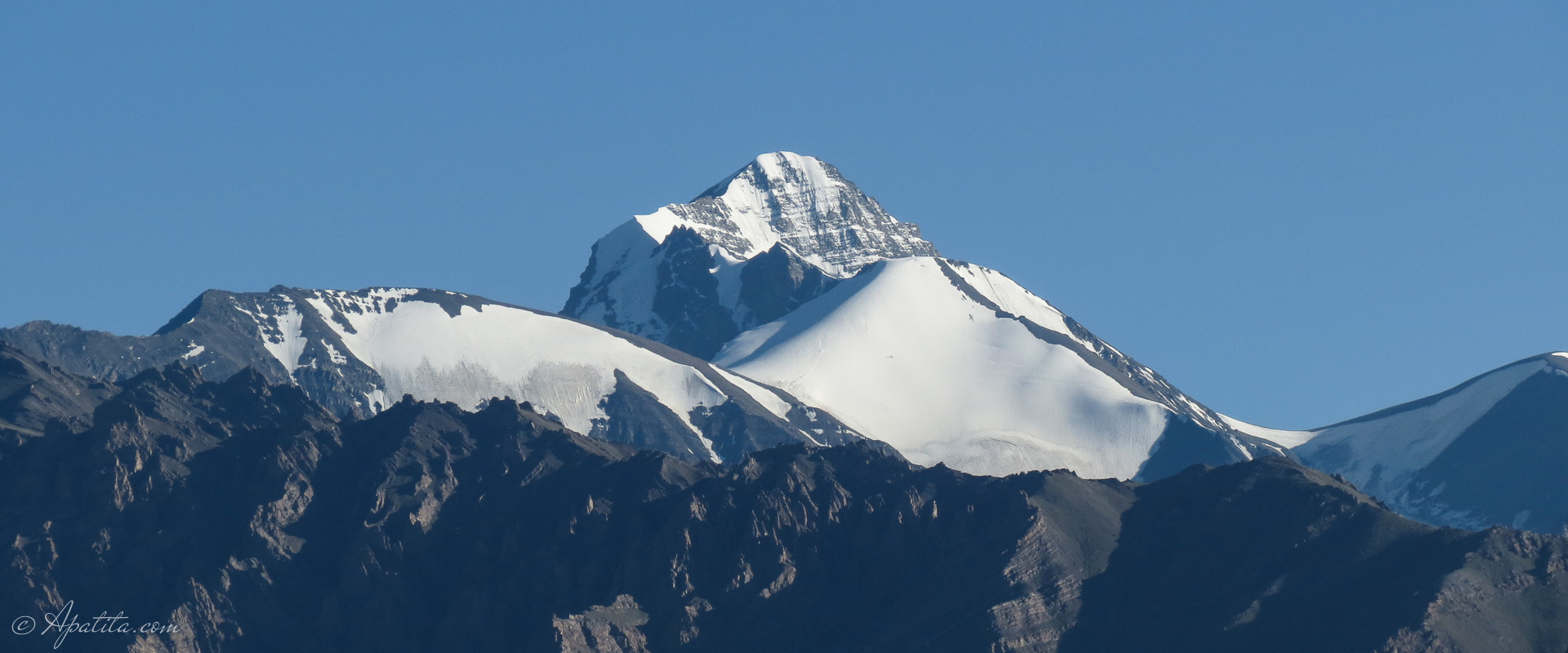
Stok Kangri (6,154 m)
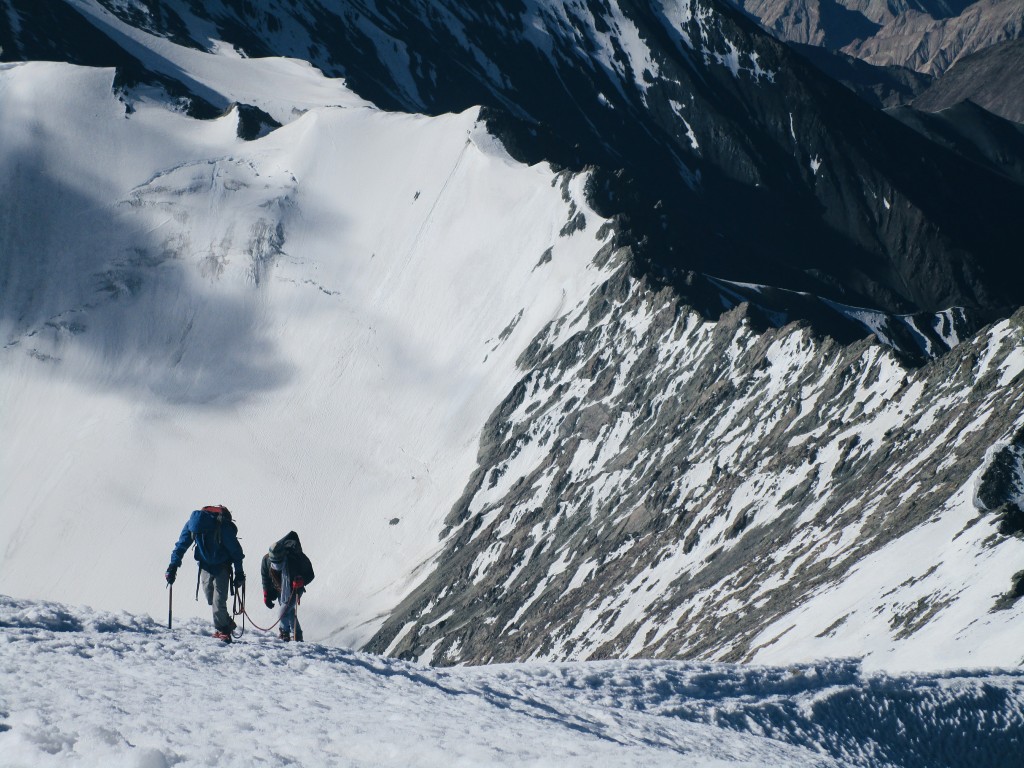
Ladakh Historical First Ascent by Pierre Vittoz 12 Aug 1951 [In the article below, Pierre Vittoz shared with us his August 1951 first historical climbing of the Stok Kangri in Ladakh. Pierre Vittoz, at 25, summitted this peak in one single day from his base camp at 5,000 m, as a solo climber, on 12 August 1951. At this time, he had been living in Ladakh for 10 months. This mountain is located in the Zanskar Range in Ladakh, approx 20 km southwest of Leh as the crow flies. Stok Kangri means "Stok snowy peak", from the neighbouring village of Stok (or "Stak" or "Stokes" for some authors). Today (2025), this massif stands among the most actively trekked mountains in Ladakh! Mainly from June to early October. That mountain has become so popular that it had to be shut off from tourists in 2021-2025 to enable Nature to recover and to protect the water sources of the Stok village... At the time, in 1951, only one other climbing attempt was known, by a Swiss party on 14-18 September 1925, as mentioned in PV's paper. Back in 1952, the Swiss journal Berge der Welt (Mountains of the World) editor Marcel Kunz was so kind as to check with these forebears the exact team composition and attempt date. In the same issue of Berge der Welt, PV's paper was preceded by a paper by Heinrich Harrer on his 1951 Panch Chuli (6'904 m) expedition with Frank Charlton-Thomas. The main peak of the Stok Kangri massif stands at 6,153 meter, 6,154 meter or 6,135 meter, depending on the sources. At this time, in August 1951, PV had been living for 10 months in Ladakh and was thus well-acclimated to 4,000-5,000m altitudes. I have discovered on 21 July 2025 at 10:30 this paper below by Pierre Vittoz proving that he had actually made the historical first ascent of this nowadays very popular Stok Kangri mountain in Ladakh. His article, written in German, with a misleading title, had gone practically unnoticed for 70 years! We should thus complete the Wikipedia pages for Stok Kangri with the Pierre Vittoz name as the first successful summitting on 12 August 1951. Pierre Vittoz made the first Summer ascent in 1951, but he first Winter ascent was achieved in 2002.] Leh, Ladakh [Quel titre opaque! Comment deviner qu'on y relate la 1ère ascension historique du Stok Kangri?] Par Pierre Vittoz Publié dans "Berge der Welt", die Zeitschrift der Schweizerischen Stiftung für Alpine Forschungen, Chefredaktor Marcel Kurz, Gunter Dyhrenfurth, Hans Roelli, Zurich, Band VII, 1952, Seite 286. Publié dans "Berge der Welt", la revue de la Fondation suisse pour la recherche alpine, éditée par: Marcel Kurz, Gunter Dyhrenfurth et Hans Roelli, Zurich, Vol VII, 1952, page 286. Source. Copie de sûreté: 21 juillet 2025. LEH-LADAK [Ascent of the Stok Kangri] Im Südsüdwesten von Leh, ungefähr 25 km entfernt, gibt es eine leicht vergletscherte Gruppe, die unter dem Namen Stok Kangri bekannt ist. Die einzige Karte, die ich besitze, ist eine französische Übersichtskarte im Massstab 1 : 1'000'000 aus dem Jahre 1902! Sie gibt für den Kulminationspunkt, der von hier aus gut sichtbar ist, 6’124 m an. Es ist eine schöne Spitze, die mich an das Bietschhorn vom Petersgrat aus erinnert, wenn sie auch nicht ganz so kühn geformt ist. Am 9. August 1951 reiste ich ab, um das ganze Gebiet näher kennenzulernen. Da ich keine passende Expeditionsausrüstung besass, musste ich auf eine ordnungsgemässe Belagerung verzichten und mich zu einer raschen Erkundung entschliessen. Ich hatte auch nur für wenige Tage Proviant mit. Nach der Überschreitung des Indus gelangte ich am ersten Tage über das Dorf Stok und durch die Schluchten südlich dieser Siedlung zu den Weiden, die sich längs dem Tal bis gegen 4’300 m hinziehen. Am nächsten Tag [10. Aug 1951] stieg ich westlich über Hänge und Moränen bis zum Rande des Gletschers auf, der vom Hauptgipfel und seinem südöstlichen Nachbarn herabfliesst. Ich errichtete mein Zelt bei etwa 5’000 m auf der rechten (östlichen) Moräne dieses kleinen harmlosen Gletschers. Am dritten Tage [11. Aug 1951], bei Nebel und Graupelschauern, begnügte ich mich damit, den Gletscher zwei Stunden weit hinaufzusteigen; dann hatte ich erkundet, was ich wissen wollte: die Südostseite des Hauptgipfels besteht aus einem gewaltigen Schneehang, der in einem einzigen Schwung von einem kleinen Bergschrund (ca. 5’300 m) bis zum Gipfel hinaufzieht. Auf der rechten Seite war der Firn von einem Felsgrat begrenzt, der, abgesehen von seiner unteren Partie, keine Schwierigkeiten bat. Tags darauf, am 12. August [1951], brach ich um 5:45 Uhr auf; gegen 7 Uhr befand ich mich am Fusse des Hanges und umging den Bergschrund auf den Felsen zur Rechten. Da der Schnee tief war, folgte ich auch weiterhin lieber diesen Felsen, die stark verwittert [érodé, usé par les intempéries] aber leicht waren. Erst weiter oben wechselte ich wieder in den härteren Schnee hinüber. Das war ein wahres Vergnügen: der Hang stieg in gleichmässiger Steilheit empor - ohne Rastpunkte, aber auch ohne Hindernisse. Um 10:45 Uhr [am 12.Aug.1951] berührte ich den Gipfelgrat [des Stok Kangris] mit der Hand. Es war mein erster Sechstausender. Die Ablesung meines Höhenmessers passte gut zur bereits genannten Kote von 6’124 m. Dann ging es rasch wieder hinunter zum Zelt, doch vergass ich unterwegs nicht, einige Peilungen mit der Bussole als Unterlage für eine kleine Kartenskizze des Massivs zu machen. In seinem Buch In Himalayan Tibet [Seeley, London 1926] berichtet Dr. Heber, der hier von 1914 bis 1925 mein Vorgänger war, dass er einmal einen Alpinisten mit seinen zwei Schweizer Führern begleitet hätte, als sie einen Angriff auf den höchsten Gipfel in einer Bergkette unternahmen, die auf der anderen Seite des Indus gegenüber Leh gelegen ist. Sie seien jedoch durch schlechtes Wetter in einer Höhe von etwa 5’500 m abgewiesen worden. Zweifellos handelt es sich hier um den Stok Kangri, aber wer waren diese Bergsteiger? In Ihrer Chronik «Himalaya 1939-1946» [BdW V, S. 204] schreiben Sie, dass Visser mit Franz Lochmatter und Johann Brantschen 1922 in diesem Gebiet waren. Handelt es sich um diese drei? [Philips Christiaan Visser, Adolph Reeve Heber, Franz Lochmatter et Johann Brantschen ont tenté sans succès de conquérir le Stok Kangri en septembre 1925, cf. plus bas. Ils ont planté leurs tentes le 15 sept 1925 à 5’460 m d’altitude, puis sont restés cloués là par les tempêtes de neige. Ensuite, le 17 septembre 1925, ils ont dû redescendre, non sans grosses difficultés.] Das Ende meiner Augustferien wurde mir leider durch Krankheit verdorben. Immerhin konnte ich Ende September 1951 schon wieder ein Pferd besteigen und über den Khardong La eine Rundtour in das Shayok- und Nubragebiet machen. Ich hatte eigentlich nur Aufgaben als Missionar zu erfüllen, aber ich konnte doch wenigstens einen Blick auf einige Gipfel werfen und einigermassen abschätzen, welche Möglichkeiten gewisse Täler als Zugangswege böten. Wie steil sind aber diese Berge ! Pierre Vittoz PS der Redaktion. Wir haben Dr. Rudolf Wyss (Bern) geschrieben, der mit der Visser-Expedition 1929/30 in dieser Gegend tätig war und uns folgendes antwortet: «Der Gipfel Stakes (Stokes) südwestlich von Leh wurde von Visser mit Franz Lochmatter und Johann Brantschen 1925 angegangen, indem sie, einen Tagesmarsch von Leh entfernt, ihre Zelte aufschlugen, dann aber umkehrten (so sagte mir Visser).» «1951 erfolgte also wohl die Erstbesteigung. Die Höhe des Gipfels, der ein sehr anmächeliger Schneeberg ist, wird auf dem Millionstelblatt 52 [Ausgabe 1916] mit 20083 ft- [6121 m] angegeben. Er lockte mich seinerzeit sehr, aber die Zeit fehlte.» «Auf der Ausgabe 1916 des oben erwähnten Blattes ist der Berg mit Kote, aber namenlos angegeben. Hingegen steht auf dem Blatt 52 F (Leh) des 14 Zoll (preliminary edition 1927) wohl der Name Stok (Stak), aber ohne Kote. Nach den Höhenkurven wäre der Gipfel etwa 4'900 m hoch. Der Name kommt gewiss vom Kloster Stak am Ost-Nordostfuss des Berges. Merkwürdig ist der beträchtliche Höhenunterschied auf diesen beiden Karten. Der 14 Zoll von 1927 sollte doch richtiger sein als der Millionstel von 1916... wer weiss Bescheid?» Dr. Ph. C. Visser schreibt uns aus Wassenaar (Holland) wie folgt: «Tatsächlich haben Herr Heber, Franz Lochmatter, Johann Brantschen und ich 1925 versucht, den Stok Kangri zu besteigen. Diesen Versuch habe ich in meinem Buch Naar Himalaya en Karakorum ziemlich ausführlich beschrieben.» «Wir verliessen Leh am 14. September (1925) und brachten unser Lager bis auf ungefähr 3'925 m. Schon am frühen Morgen des 15. September verschlechterte sich das Wetter. Jedoch verfolgten wir unsere Besteigung, und neun Stunden später erhoben sich unsere Zelte auf einer Höhe von 5'460 m. Dann waren wir reichlich 600 m unter dem Gipfel. Die angegebene Höhe von 6’121 m ist also sicher richtig.» «Es brach dann ein schauderhafter Schneesturm los. Wir warteten noch bis am Nachmittag des nächsten Tages [16. Sept 1925]. Dann waren wir gezwungen, mit ziemlich grossen Schwierigkeiten bei äusserst schlechtem Wetter zurückzukehren.» Die Besteigung [des Stok Kangris] unseres tapferen Mitbürgers Vittoz scheint also die erste zu sein, und wir gratulieren ihm für diese einsame Leistung. M. K. (Marcel Kurz, editor) A witness: A very useful testimony written by a “normal” alpinist/trekker on how it feels to climb the Stok Kangri. Mt Stok Kangri Trek in Ladakh: All you need to know by Traveller's Blog / Monday, 03 February 2020 / Published in Ladakh, Climbing Expeditions Safety copy 30 July 2025. Source. A couple of days back I was looking to plan a trek in Leh. It was winter and I felt a sudden urge to go trekking in the mountains. Scrolling through my options, I came across an article talking about the ban on the Mt Stok Kangri trek in Ladakh. I immediately started reading as much information as I could. About the ban, the causes and anything I could google. Reading these articles, I began to reminisce about my experience on this beautiful mountain. Mt Stok Kangri Trek Image of Mountain Peak It all started when my friends and I came back from the Mt Everest Base Camp Trek. After a successful trek, we were looking to climb even higher. Plus, I had heard that Mt Stok Kangri was easy to achieve peak and even amateurs were able to climb it. Being about 600 m higher than Mt Everest Base Camp, it sounded very exciting. I should mention here that we all were 15 years of age. Despite this, we felt confident after our performance on the Everest Base Camp trek. Looking back, I must say, Mt Stok Kangri trek is by no means easy. Although they say it is a non-technical mountain, some prior knowledge would be very helpful. At one point, I remember walking on a narrow ridge with a hundred ft drop on either side. Oh, and did I mention the extreme cold and the strong winds trying to push you off? At the height of 6'153 m, Mt Stok Kangri is one of the highest trekkable mountains in the world. In comparison, Mt Kilimanjaro, the highest mountain in Africa, is at the altitude of around 5'895 m. Due to its altitude and accessibility, it’s very popular among Indian and international climbers. It serves as an entry point for amateur trekkers, as well as seasoned mountaineers. The terrain makes it ideal for practice and training for higher mountains. Adventure Pulse Image of Trekkers on Snow with Gears Also, there is another high altitude trek with similar features called Kang Yatse II trek. Offering a similar experience, this is also a non-technical trek at a height of 6250m, but is not as well known. In spite of these similarities, it hasn’t seen the same extent of commercialization as the Mt Stok Kangri trek. These treks have been a boon for the economy of Leh and its people. It is contributing to the already thriving tourism industry in the region. Mt Stok Kangri trek attracts a wide spectrum of climbers. So, there has been an increasing number of tour operators to cater to the increasing numbers. As a result, Leh and the Stok glacier have experienced a large and unchecked influx of tourists. This has lead to irresponsible tourism and uncontrollable over-commercialization. My expedition with the team of Adventure Pulse started as the season was ending. We were lucky not to encounter large numbers along with us, although we did meet a couple of climbers on our way. The months of July and August are the peak season for these high altitude treks. During this period, large numbers of climbers flock to this glacier, putting a toll on it and its limited resources. Mt Stok Kangri Trek Along with depleting oxygen levels and cold temperatures, its high altitude makes an ascent dangerous if proper safety measures aren’t followed. A few years back, the body of a climber from Punjab was found frozen on the summit. It was later found out that he was climbing without a guide or proper equipment. I have personally seen many trekkers not following adequate acclimatization practices before climbing. This eventually causes greater problems higher up on the mountain and can even lead to severe AMS. There has been a rising number of deaths and accidents on the mountain due to the neglect of proper mountaineering practices. Also, many expeditions focus on cost over safety, with a focus on leading mass expeditions up the mountain. Expeditions led on the mountain generate a lot of waste. I have also observed another factor between Mt Stok Kangri and other mountains I’ve climbed. The beautiful river flowing throughout the route and along the campsites can act as a convenient waste disposal system. The way expeditions generally deal with waste on the mountain is a bit different. We have to dig holes and pitch up toilet tents. Also, you have to carry other heavy waste up and down the mountain. The river just offers an easy solution to these problems. Not only are these practices unethical, but they are also highly unsustainable. They cause irreversible environmental damage to the mountain and the glacier. The trek begins from the Stok Village, established around the river flowing through it. It is about an hour’s drive from the city center and acts as the starting point for the Mt Stok Kangri Trek. For generations, the local community of Stok village has depended on the glacier as a source of water. However, in recent years, there has been an increasing number of mountaineers and porters passing through it. Their constant movement up and down the mountain pollutes the only source of water for the village taking away a major part of their sustenance. Besides this, the Meteorological department reported an increase in local temperature by 1-5 degree C. This alarming discovery initiated a response from the authorities and the locals. The ‘Stok village committee’ and the ‘All Ladakh Tour Operator’s Association’ have taken a call to protect the region. They have closed the Mt Stok Kangri trek for all expeditions from 2020 to 2021. This decision will certainly have an adverse economic impact on the city of Leh and its locals. Still, the authorities and locals gave a positive response, taking a step to protect the mountain and prevent irreversible damage. The government has now announced the closure of the trek from 2020. There is a need to look at different solutions to ensure such a situation does not repeat itself. The Chadar frozen river trek is also facing the same issue. It also suffers similar problems of unsustainability and over-tourism each year. I was lucky enough to experience the grandeur of Mt Stok Kangri trek. With its massive glacier and a panoramic view of the Karakoram ranges, this majestic mountain altitude peak. certainly has its own allure. I would have recommended it to anyone looking to climb their first high altitude mountain. The decision to close it, although disheartening, is nothing short of logical. Certain measures to protect it now seem unavoidable and I believe they have been taken in the best interest to preserve this unique peak. There are numerous ongoing discussions on global warming and its prevention. As an integral part of this, the conservation of nature plays a fundamental role in making our planet greener. The tour operators have to change their approach to organizing expeditions. Also, we as trekkers bear the crucial responsibility to maintain the surroundings we climb in. Plan every trek with the goal of ‘leave no trace behind’ in mind. This type of ecologically sustainable trekking seems like the only solution to such problems. It may help to avoid more of such measures to protect the very mountains we dream of climbing. While Mt Stok Kangri trek remains closed, there are alternatives such as Kang Yatse I and II in the same region. Kang Yaste II is also a non-technical climb that offers a similar experience to Stok. It will be interesting to see how commercial expeditions are now led on these mountains in the light of the recent action taken to preserve Stok. We’ll have to wait and see if the expeditions are led in a more ecological and sustainability-focused format. But I must say Mt Stok Kangri Trek in Ladakh was one of the Best Adventure Trek ever. Kanishk Pande, at the age of 19 years, is an avid mountaineering enthusiast having trekked the Everest Base Camp in Nepal, Mt Kilimanjaro in Africa and Mt Stok Kangri trek in Ladakh; to name a few. His passion for the mountains is evident in his drive and his words, on ecological sustainability giving credence to the fact that we all play an integral role in conservation. Frequently Asked Questions About Mt Stok Kangri Trek and Sustainable Trekking in Leh 2. Is Mt Stok Kangri suitable for beginner trekkers? While considered non-technical, Mt Stok Kangri (6153m) is challenging due to its high altitude, extreme cold, strong winds, and narrow ridges. Prior trekking experience, proper acclimatization, and guidance are highly recommended, even for amateurs. 3. What are the risks of trekking Mt Stok Kangri? Risks include altitude sickness (AMS), extreme weather, and dangerous terrain like narrow ridges with significant drops. Neglecting acclimatization, lack of proper gear, or climbing without a guide has led to accidents and fatalities. 4. What is the best time to trek in the Leh region? The peak season for high-altitude treks like Mt Stok Kangri and Kang Yatse II is July and August, offering favorable weather. However, this period sees heavy crowds, impacting sustainability. Late season treks (e.g., September) may have fewer climbers. 5. What are alternative treks to Mt Stok Kangri in Leh? Kang Yatse II (6250m) is a non-technical trek offering a similar high-altitude experience with less commercialization. Kang Yatse I is another option. Both provide stunning views of the Karakoram ranges and are less crowded. 6. How does trekking impact the environment in Leh? Over-tourism has led to waste accumulation, water pollution, and glacier degradation. Unsustainable practices, like using rivers for waste disposal, harm local ecosystems and communities reliant on these resources. 7. How can trekkers practice sustainable trekking in Leh? Adopt a ‘leave no trace’ approach: carry all waste back, use designated toilet facilities, respect local resources, and follow proper acclimatization. Choose tour operators prioritizing safety and sustainability over cost. 8. How does the Mt Stok Kangri trek compare to other famous treks? At 6153m, Mt Stok Kangri is higher than Mt Kilimanjaro (5895m) and slightly higher than Everest Base Camp (~5364m). Its accessibility makes it popular, but its challenges require preparation unlike easier treks. 9. What role does tourism play in Leh’s economy? Treks like Mt Stok Kangri significantly boost Leh’s economy through tour operators, guides, and local services. However, unchecked tourism has led to environmental damage, prompting temporary bans to preserve the region. 10. Can young trekkers attempt high-altitude treks like Mt Stok Kangri? Yes, but with caution. The author completed the trek at 15, but prior experience (e.g., Everest Base Camp), proper training, acclimatization, and expert guidance are crucial for safety, especially for young trekkers. Conclusion The Mt Stok Kangri trek, a breathtaking adventure at 6153m, has captivated trekkers with its majestic glacier and Karakoram views, serving as an accessible yet challenging high-altitude climb. However, its closure from 2020 to 2021 due to over-tourism, pollution, and environmental degradation highlights the urgent need for sustainable trekking practices. The impact on Stok Village’s water resources and rising local temperatures underscore the delicate balance between adventure tourism and conservation. Alternatives like Kang Yatse II offer similar thrills with less commercialization, providing hope for responsible exploration. As trekkers, adopting a ‘leave no trace’ mindset and choosing eco-conscious operators like Adventure Pulse is vital to preserve these pristine landscapes for future generations. Kanishk Pande’s journey reminds us that while mountains inspire, their protection is our collective responsibility. About Traveller's Blog Traveller's Blog is a platform where people share their travel stories, their trekking & hiking experiences and much more. If you want to share your travel story, write to us at info@adventure-pulse.com
Ajouté 07 sept 2025; modifié 07 sept 2025
|


|
Created: 07 Sep 2025 – Last modified: 28 Jan 2026
|